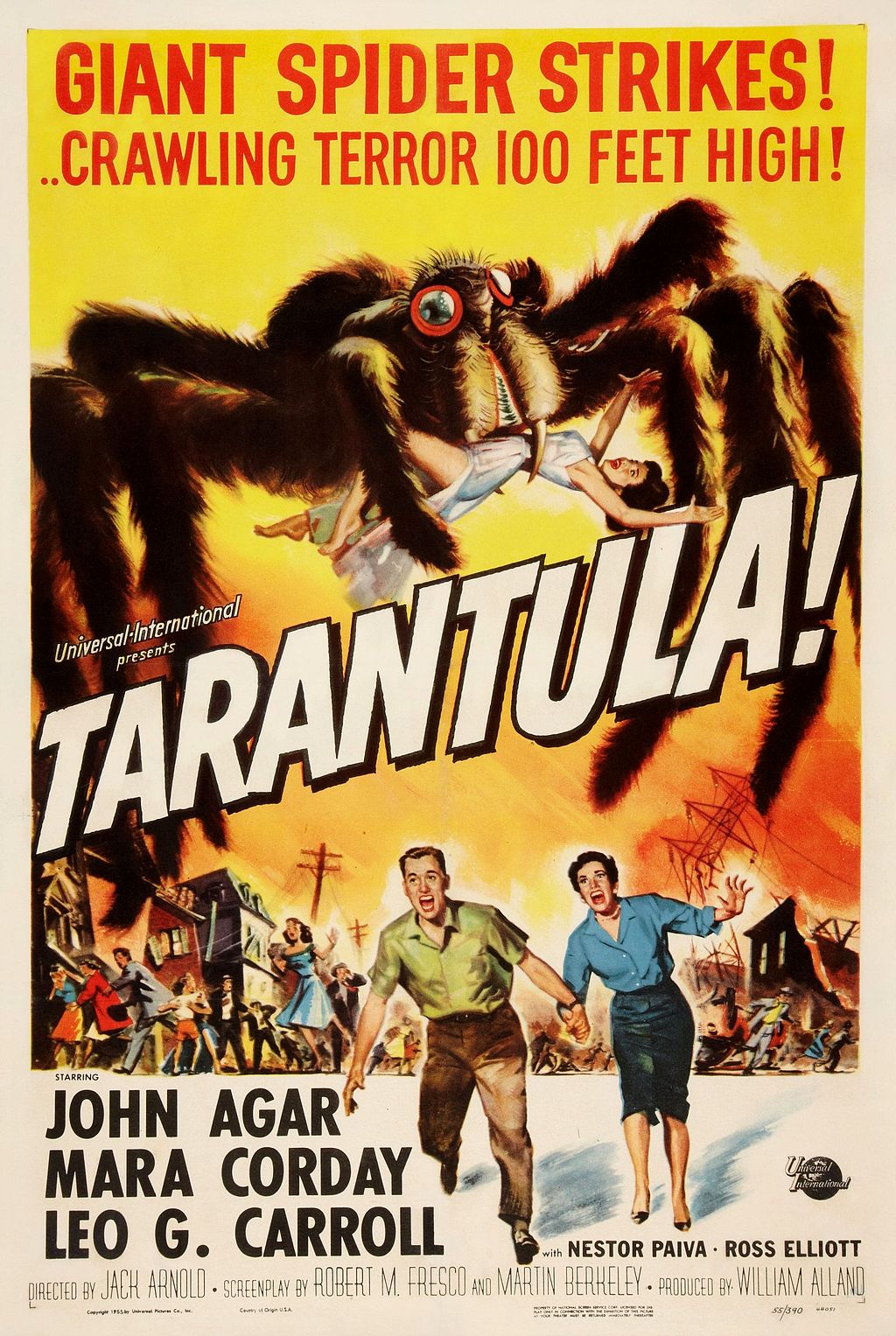
• Embrace Your Inner Moonscape

    In the city, we had a gardener. Jose arrived on our cul-de-sac in his beat-up truck and trailer on Friday mornings at 9:00 a.m. sharp. After mowing, edging, and trimming our yard, he walked across the street to his next account and so on until the yards he tended were immaculate by noon.

    We chose a tropical theme for our city oasis. Queen’s palms surrounded our loosely Mediterranean-style tract home, interspersed with Birds of Paradise, Jasmine, and Lily of the Nile. Our grass, smooth like a putting green, had borders of pansies in the winter and marigolds in the summer. Our focal point was an impressive grove of Sego Palms that grew underneath our living room window, and we sold their pups.

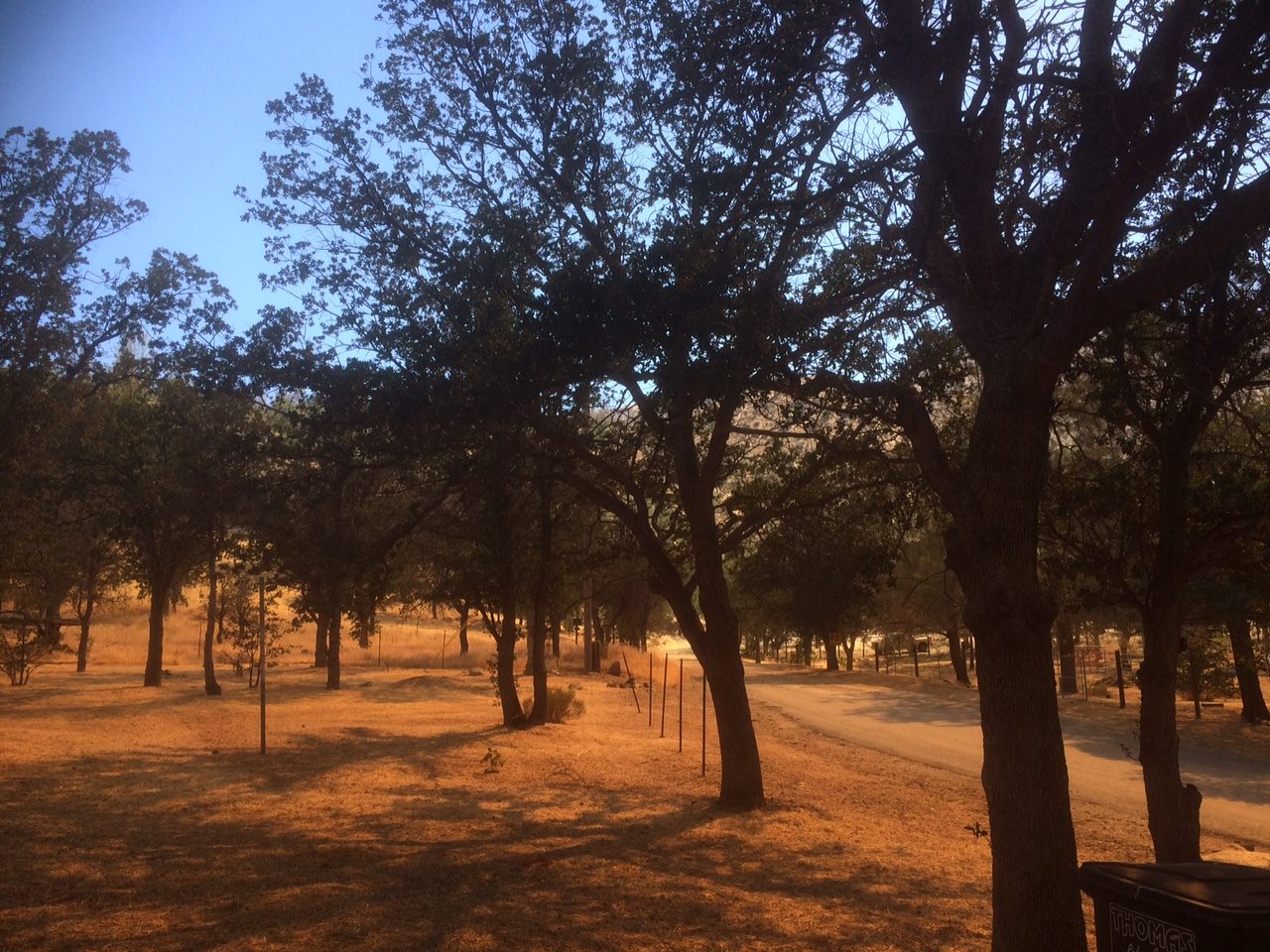
    Located in a high desert climate of sagebrush, natural grasses, oak, and pine trees, Cook Peak looked fancy, set on a hill with a sloping lawn while most of the neighbors sprayed their yards into barren moonscapes. Others utilized drought-resistant plants interspersed with river rock and wagon wheels for low maintenance. With the outrageous cost of water and the threat of wildfire, greenery was kept to a minimum and gardeners out of a job. As newbies transplanted from the city, we could not live without grass. Embracing our hubris, we purchased lawn equipment and mowed on Fridays like Jose.

    In the backyard and side yards around Cook Peak, thick ground cover bloomed with purple flowers in the spring. Worried about rattlesnakes with so much foliage to hide, we killed the ground cover out of fear and blamed it on the high cost of water. Meanwhile, our thirsty fescue lawn demanded water three times a day. We planted bushes and flowers we knew from the city, but they died in the soil as hard as concrete. Afraid of fire, we cut down the wall of Junipers that surrounded Cook Peak. Eventually, deer discovered the hedge out front, and the mistletoe choked the oaks. During the California drought in 2013, we killed the lawn. At first, we felt empowered for doing our part to save water, but after the Erskine Creek Fire in 2016, we longed for green again.

    June marks our 16th year at Cook Peak. It was only last fall that we embraced drought-resistant plants and built a privacy fence in the front yard worthy of Sunset magazine. Flowers now grow in terracotta pots. Just last week we hauled truckloads of rock from the river to replace our once grassy knoll. Creating a mountain oasis takes time. Some might say the only thing missing at Cook Peak is a wagon wheel. Don’t worry; we’ll probably get there someday.


    This slideshow requires JavaScript.


  • Silverado

    Cook Peak Review, 2005  |  By Liz Cook, Edited

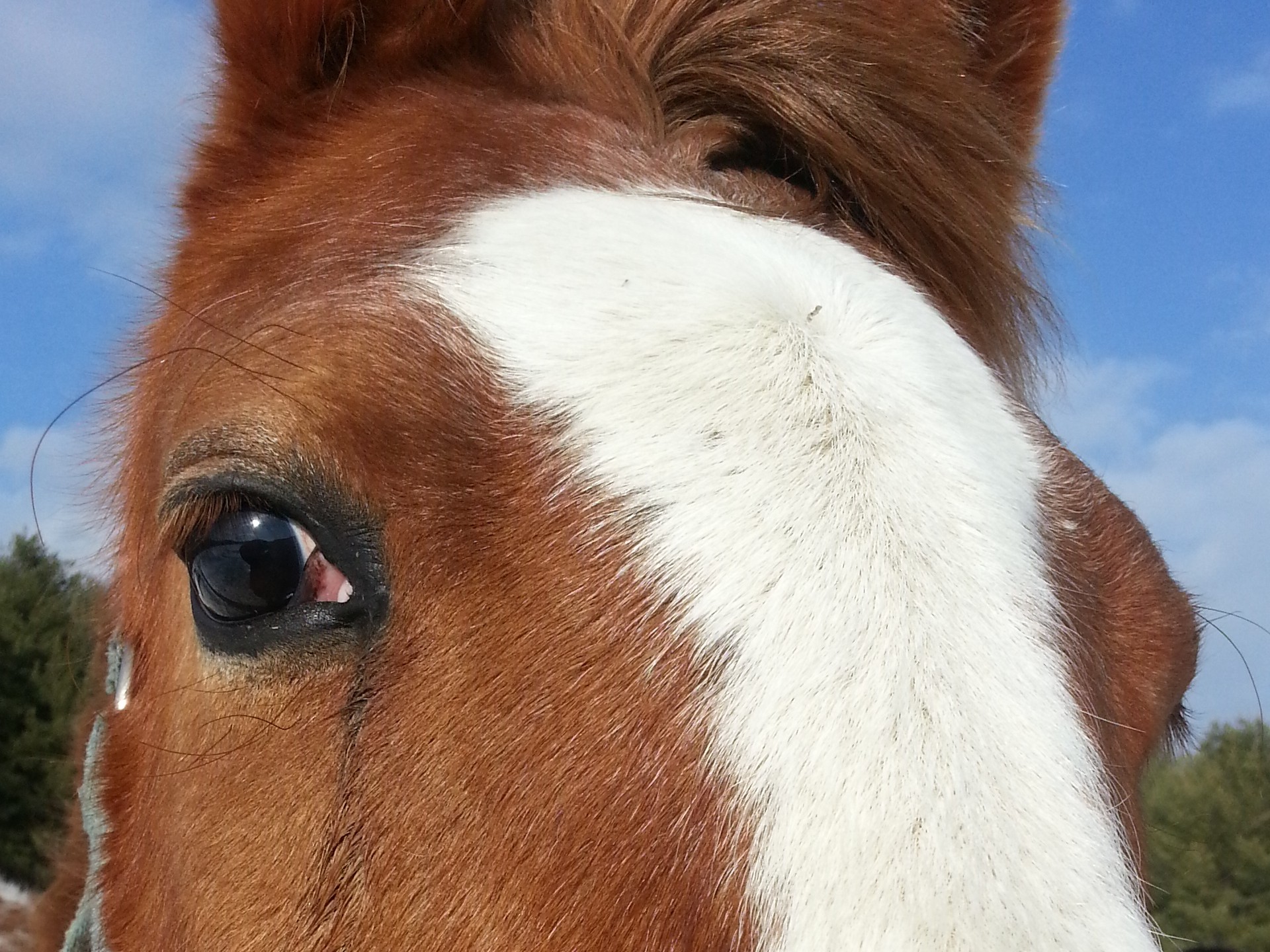
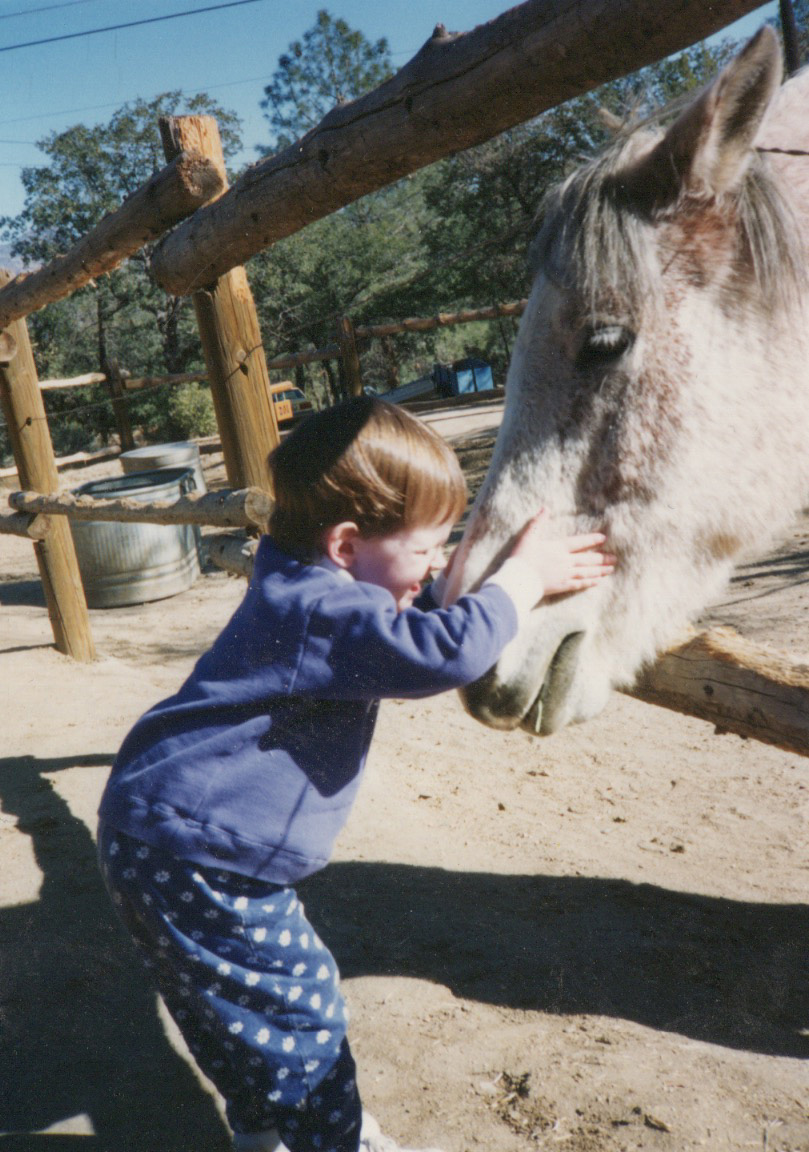
    Every girl should own a horse. Before we moved to Cook Peak, the only horse I owned was made of plastic. My wildest dream came true when my grandparents gave me their horse; an Arabian named Silverado. I was the happiest girl in the universe because I owned a horse.

    My grandparents had Silverado for over ten years before I got him. He was born on the Californa coast, trained at Cal Poly, San Luis Obispo, and spent the majority of his working years as a pack horse in the Sierra Nevada wilderness. My Grandpa met Silverado on the trail and the two eventually retired together.

    When I was a little girl, I couldn’t wait to visit my grandparent’s house so I could see Silverado. He lived in the corral in front of their mountain cabin. I would pet his giant head through the bars, and he let me as if he sensed the innocence of my size and intentions. My Grandpa would get nervous, thinking Silverado could easily step on me.

    My Grandpa was surprised the day I asked if I could ride his horse. I was in Jr. High. He said Silverado had not been ridden in a very long time and he wasn’t sure how the horse would react to a saddle. By the time he put on his boots and came outside to saddle Silverado, I was already done. Months of riding with my neighbor and learning how to care for her horses had paid off. Silverado was saddled and ready to ride. I think that was the turning point when my Grandpa knew I was ready to own a horse.

    A couple of months later, my grandparents offered Silverado to me. I was so excited and counted the minutes until he was mine. On a warm summer evening, Silverado arrived at Cook Peak in a horse trailer. We put him in a small pen in the back pasture to help him get used to his new home. I will always remember the first time we let him into the big pasture. As soon as he cleared the gate, he galloped for the first time in many years, up and down the pasture. It was a beautiful sight, watching him do what horses were meant to do, run. Because Silverado was an Arabian, he held his head up high and arched his long silky tail. There was no doubt in our minds that he needed me as much as I needed him.

    I showed Silverado how to be a horse again. Together we traveled every road and trail in our valley and visited every horse and along the way. We didn’t have television or video games. Instead, we rode horses and went on adventures. Silverado took good care of me and kept me safe. Our Ferrier, once told me that if you take care of your horse, your horse will take care of you, and it’s true.

    One day, Silverado and I rode to the lake with Corrine and her horse, TC. We loved to ride in the wide open spaces and gallop. When Silverado and TC were tired, we took them to the shoreline to cool down. Usually, you cool down a horse by walking him slowly, but Silverado had other plans. He sat down in the lake with me on his back and took a bath. Watching us was an amazed audience of tourists.

    Silverado and I had some difficult times. My mom had left to go to the store one day while I saddled Silverado next to the chain link fence like I had done many times before. We were going on an early evening ride with Corrine and TC around the neighborhood. I did everything as usual. I put on his blanket and then his saddle. Strangely, when I put on his bridle, he reared and landed on top of the fence and crushed it. Half of his body was on one side, and his back end flailed on the other as he screamed. There was nothing I could do except wait for him to calm down. I could see his halter caught in the fence. Somehow I managed to get his saddle off and noticed his leg was bloody and caught in the wire. Without adults around, Corrine and I had to think fast. We found wire cutters and cut Silverado’s foot away from the fence. Just before I freed him, I thought to myself; this horse weighs 1,500 pounds, and one wrong move could send me to the ER. In this frightening time, I remembered the Ferrier’s words.

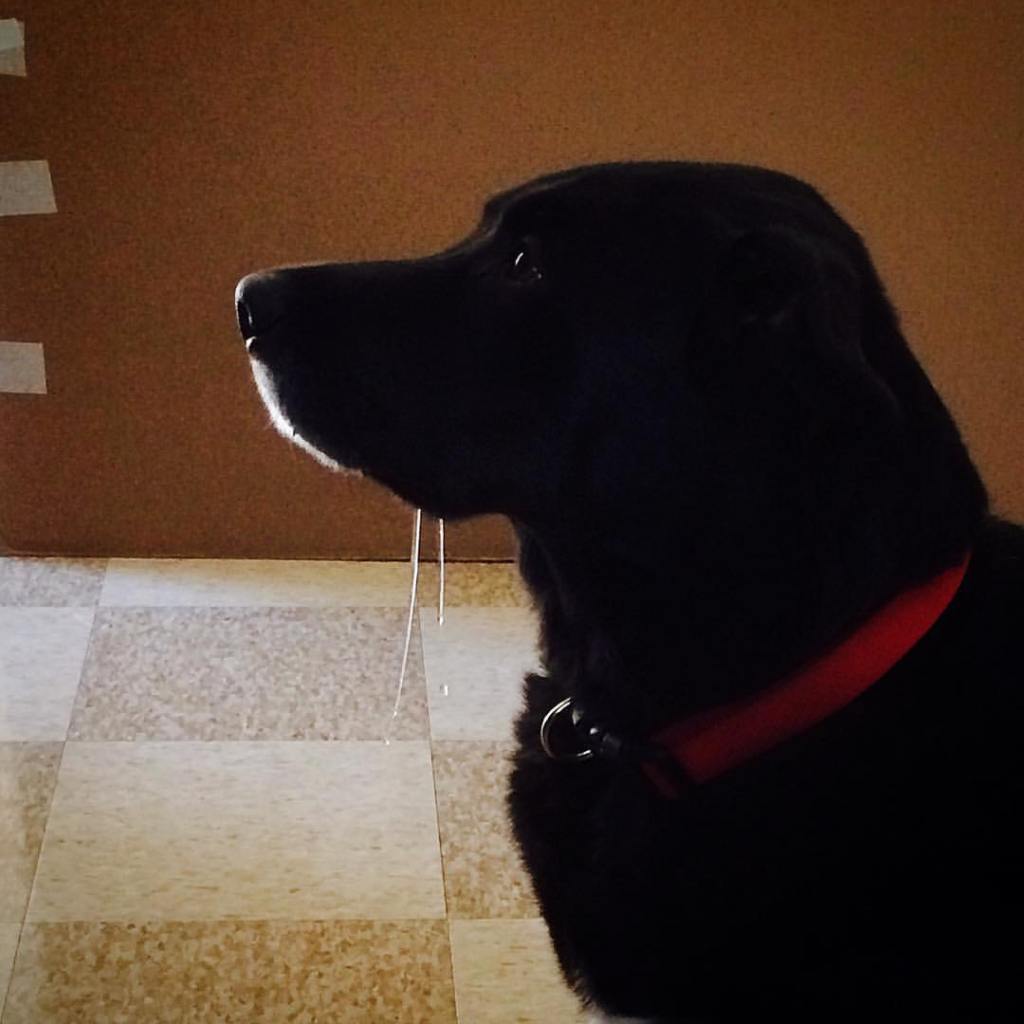
    At the end of a summer evening, Silverado got sick. It wasn’t his first bout of colic, Grandpa said. Within hours he went from bad to worse, and by morning, he stood in the pasture, weak and hopeless. He tried to ease his pain by walking a few steps back and then forward. Mucus dripped from his nose and mouth like a faucet. All I could do was pet him and cry. He knew I was there. He leaned his body into mine and laid his head on me. I think he knew he would die.

    The vet said there was nothing he could do but end the suffering. As the vet’s wife walked Silverado into the middle of the pasture, he looked at me for the last time, and I cried. The vet said he didn’t want me to watch my horse die and asked me to leave. I went inside Cook Peak and up to my parent’s balcony and watched the whole thing. I had to. The vet’s wife lovingly held Silverado’s head, as I would have, petted him and gently comforted as Silverado collapsed and left the earth.

    Tulsa, our other horse, unfortunately, had to watch his friend suffer and die and get buried only yards away. Once the backhoe left, Tulsa walked over the grave and laid down. After Silverado’s death, Tulsa became more affectionate. I gave him all of my attention, and together we processed the loss of our friend.

    I have learned that death is a price you pay when you live on a ranch or farm or whatever Cook Peak is. I’ve experienced the joy at the beginning of life, and I’ve experienced the bitter end. Living with loss is difficult, but I will always remember Silverado with fond memories of my childhood.

    Yesterday I walked out to the pasture and stood on Silverado’s grave. I wanted to spend a few quiet moments thinking about the good times and our adventures. Tulsa saw me and walked over and nuzzled his face against my back. I turned and said, “Come on boy, let’s go. Today is a good day for a ride.”

    Silverado, 1979-2005

    This slideshow requires JavaScript.

    Liz is now 27 years old and a cosmologist in Phoenix, AZ. During her childhood at Cook Peak, she loved Silverado, Tulsa and Amber, all older horses who lived out their lives at Cook Peak. 

  • The Spider

    Liz chose the larger of the two bedrooms. The draw of a spacious walk-in closet, and a window with a view of the lake if you stood on your tippy-toes, made the decision easy for a pre-teen. She decorated her walls with boy band posters and her shelves with nicknacks from her fleeting childhood.

    Inside her walk-in closet was a rickety attic door. It opened into a considerable space above the first story and was packed with rafters, air conditioning ducts, insulation, and a giant discarded roof-mount antenna from the 70s. It would later become the perfect hideaway for contraband.

    Early one summer evening, Liz was in her room organizing. Her favorite band played on the stereo as she straightened her dresser and reattached posters with gobs of masking tape. Ready to hang her clothes in her closet, she turned, and there it was, a tarantula on her bedroom wall.

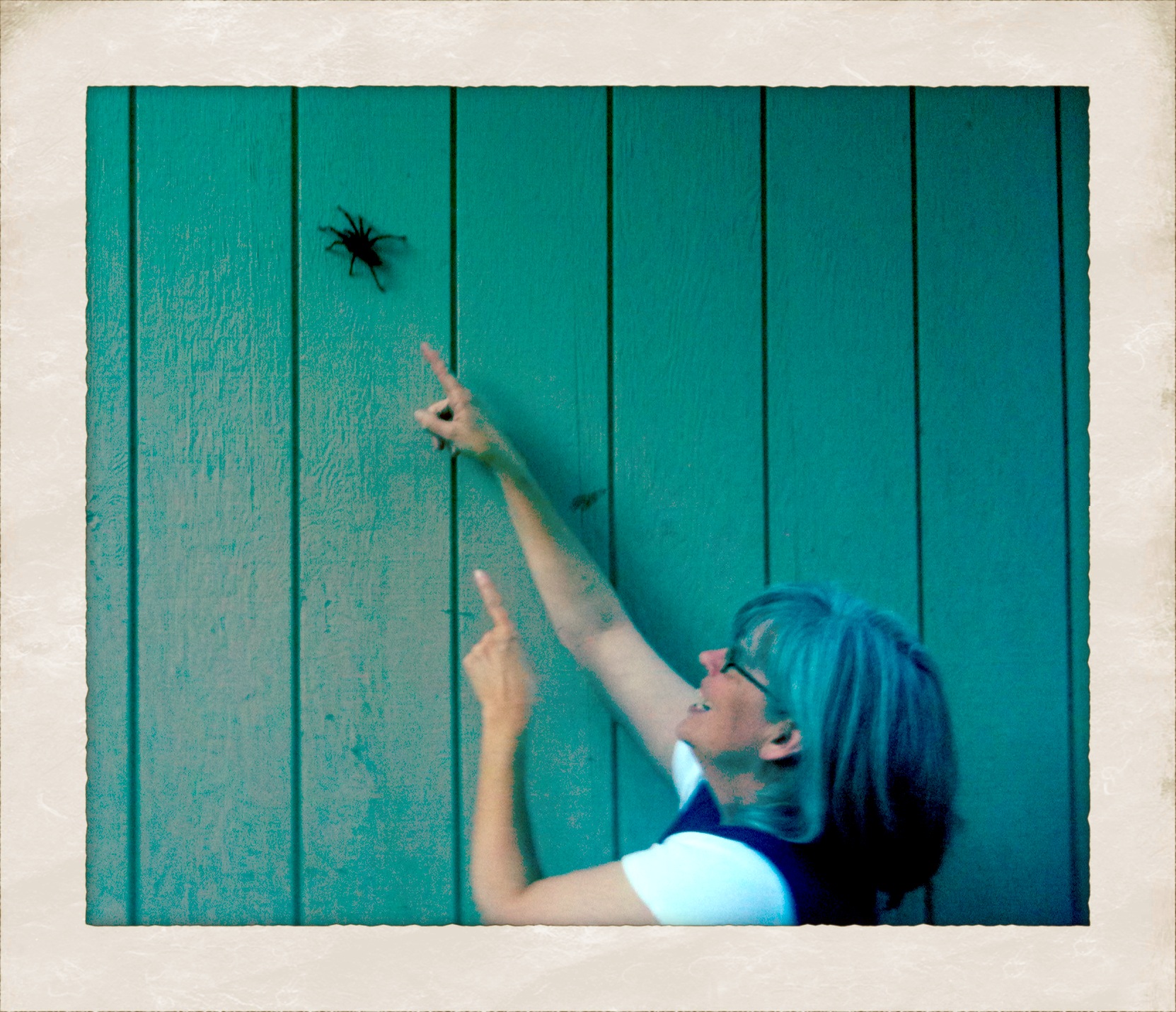
    Liz hates spiders. She always has and always will. When we lived in the city, she feared the little spiders, the jumping ones, the daddy-long-legs, and her dad squished them for her. But this was not a city spider. Liz backed away from the monster on her bedroom wall, and screamed, get it out, get it out, as the rest of us crowded into her bedroom. A tarantula, the size of my hand, clung to the wall next to a face on a boy band poster. Even though Ellen and I knew it wasn’t nice to laugh, we couldn’t help ourselves. Liz was in a tizzy, and there was a tarantula inside Cook Peak.

    Because tarantulas are too big to squish, David found a paper bag and tried to capture it. Startled, the spider sprinted up the wall, and everyone jumped and screamed. When it stopped, David flicked the arachnid into the bag with a pencil, where it landed with a thump. Holding the bag at arm’s length, he walked the spider downstairs, out the front door and into the gravel driveway. It was a windy evening with gusts up to 20 mph. We gathered to watch the release, expecting the spider to scurry away, but when David opened the bag, the wind ripped it from his hand. Bag and spider shot up into the sky like a rocket and sailed over the neighbor’s house and disappeared.

    Tarantulas are common at Cook Peak. After the shock of seeing your first wears off, they are no more frightening than a butterfly or a ladybug, unless you’re Liz, of course. Most of the spiders we see around the house or on the street are males looking for a lady friend. But during a summer downpour, they’re forced to move to higher ground and scurry up the stucco on our house. Some find the holes under the eaves and squeeze into the attic space, and if the attic door in Liz’s closet is left ajar, we get visitors.


    1040690_10201580792900832_1380706058_o

  • The Fire, Part 2

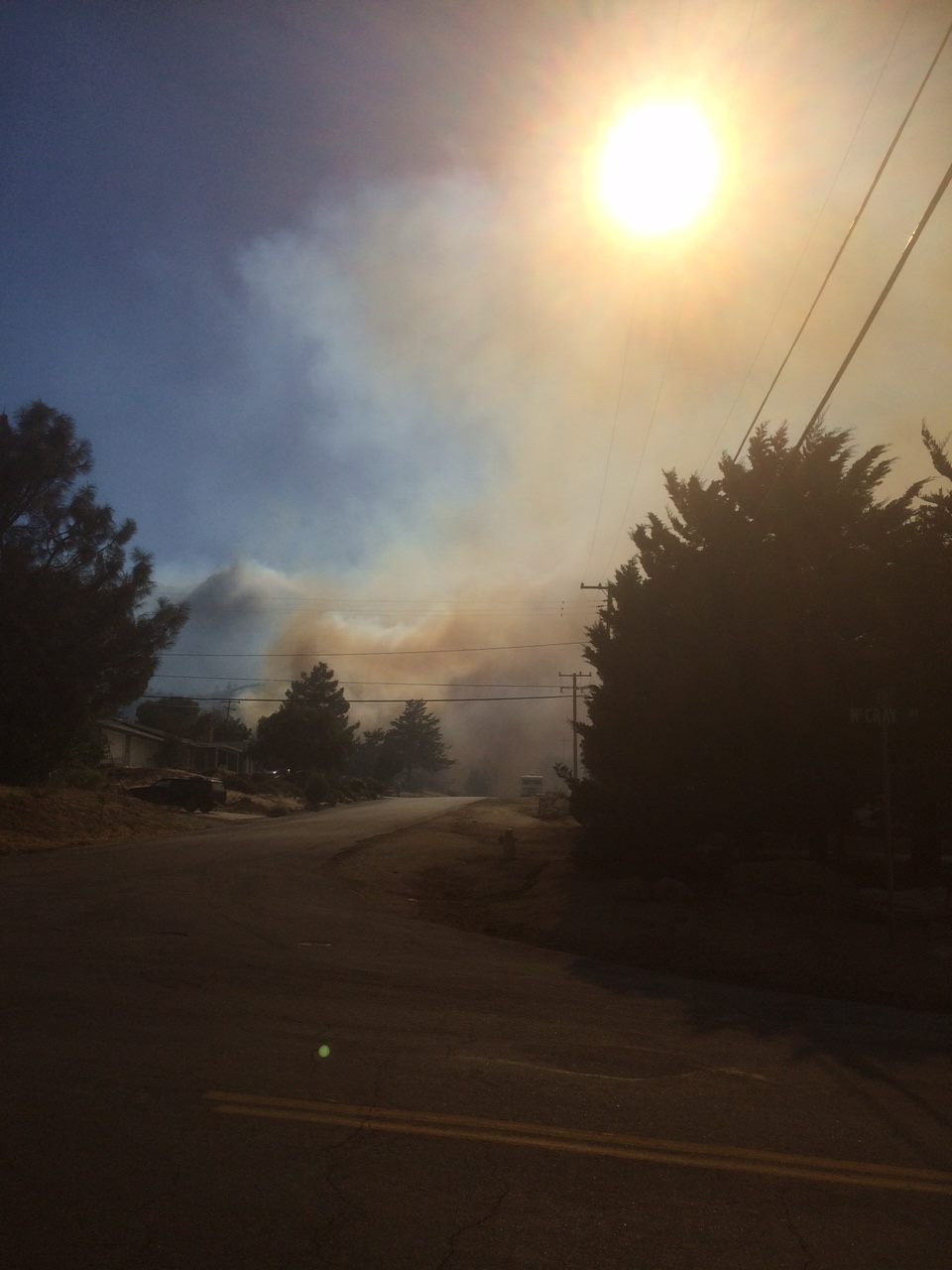
    Mt. Mesa was in chaos. I stood on the street corner by the local market and watched for my in-laws, for David, for anyone to find me. There were many cars, horses and people who stood in shock like me with saucer eyes. Emergency vehicles with sirens sped up McCray toward the fire and disappeared into the wall of smoke. There was nothing I could do but cover my mouth with my sleeve and wait. I couldn’t call anyone. My cell phone didn’t work. Someone said the tower on top of Cook Peak mountain had incinerated.

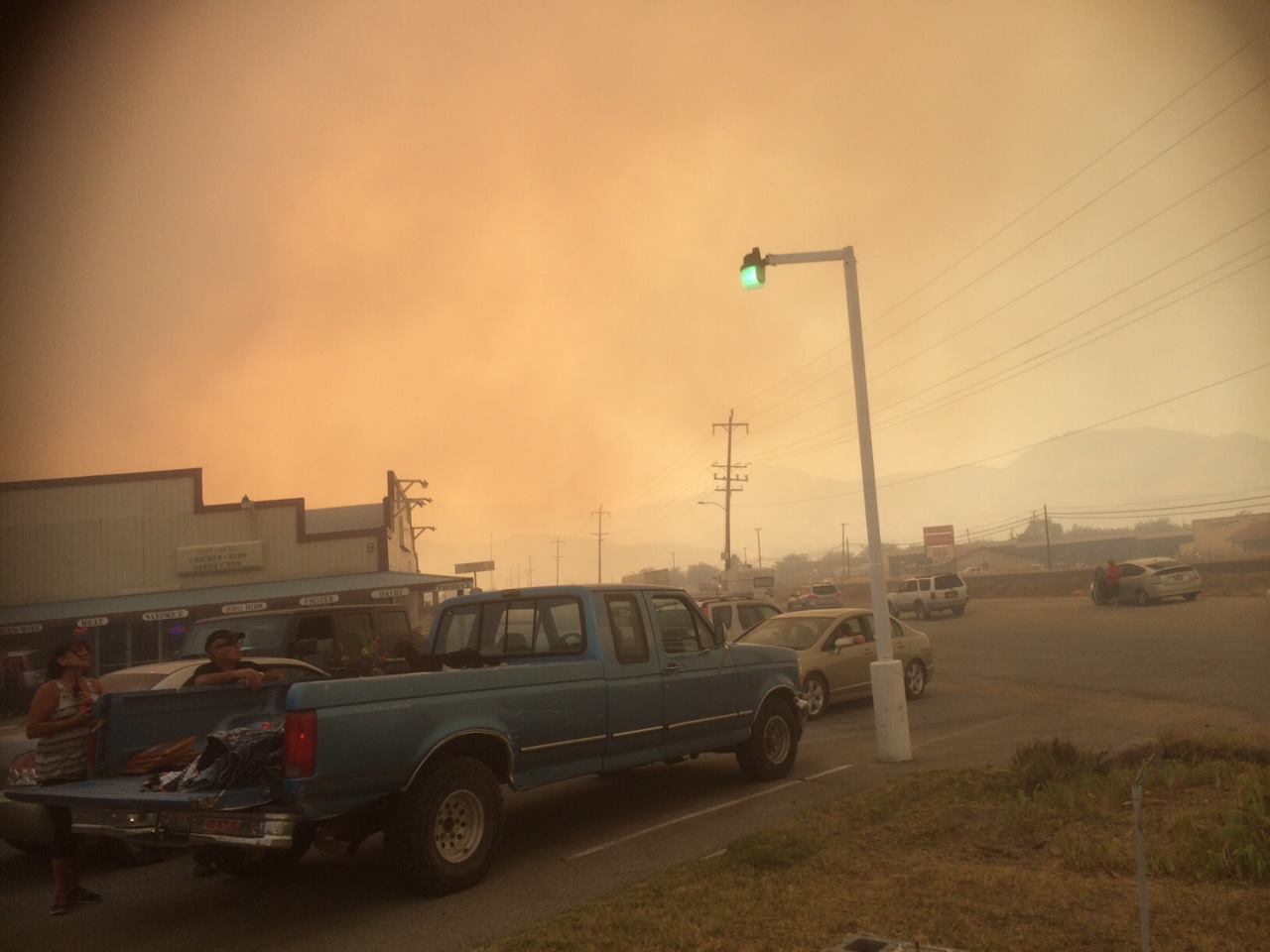
    Do you see the people standing next to the blue pick-up truck in the photo below? I don’t know who they are, but I latched on to them. We engaged in nervous conversation about our evacuation and rescuing our animals. In the back of their truck was their young goat. Their two small dogs were in the cab.
    13613188_10210028941419265_9021504971779548144_o

    They said the fire started on the other side of Cook Peak mountain near Erskine Creek. That made sense. All the noise I heard earlier when the fire was just smoke on the crest was from the air bombers and helicopters fighting on the other side of the mountain to keep the fire from spreading west into Lake Isabella.

    And then David drove by and sped up McCray. There was too much commotion for him to notice me flailing my arms. Later he said he made it to the first barricade. When stopped, he told the officer his wife was still up there, and he had to get through. At the second barricade, a firefighter covered in pink flame retardant warned that if he passed, there would be no one to rescue him. David made it 100 yards farther when the smoke turned black. He couldn’t see the road or the familiar landmarks. Suddenly, a house burst into flames. A propane tank exploded. Both sides of the road were on fire, and the wind blew the flames like a blowtorch. It was a war zone. Driving towards him from out of the smoke was a man in a truck who yelled to turn back, there was nothing left. The power lines above were bouncing and melting. David knew there was nothing he could do, except go back to Mt. Mesa and pray to God that I was there. And I was, along with a bazillion other people.
    13584805_10210028941499267_8906779245685927300_o

    David and I drove away from Mt. Mesa as an army of emergency vehicles poured into Squirrel Valley. We were fortunate to have relatives in the valley and were evacuating to my in-law’s house in Wofford Heights on the other side of the lake. It felt weird leaving Cook Peak behind, not knowing if we’d have a home to come back to. I worried about the fate of my critters, knowing there was nothing I could do to save them. My potbelly pigs were trapped in their pen with no way out. The chickens were locked in their coop. The last time I saw Mr. Leonard and Ruthie, my cats, they were in the yard. How could any of them survive such a hell? I kept looking back toward home, imagining Cook Peak in the midst of all that smoke, fighting for its life.
    13584770_10210028941459266_7304233731130737774_o

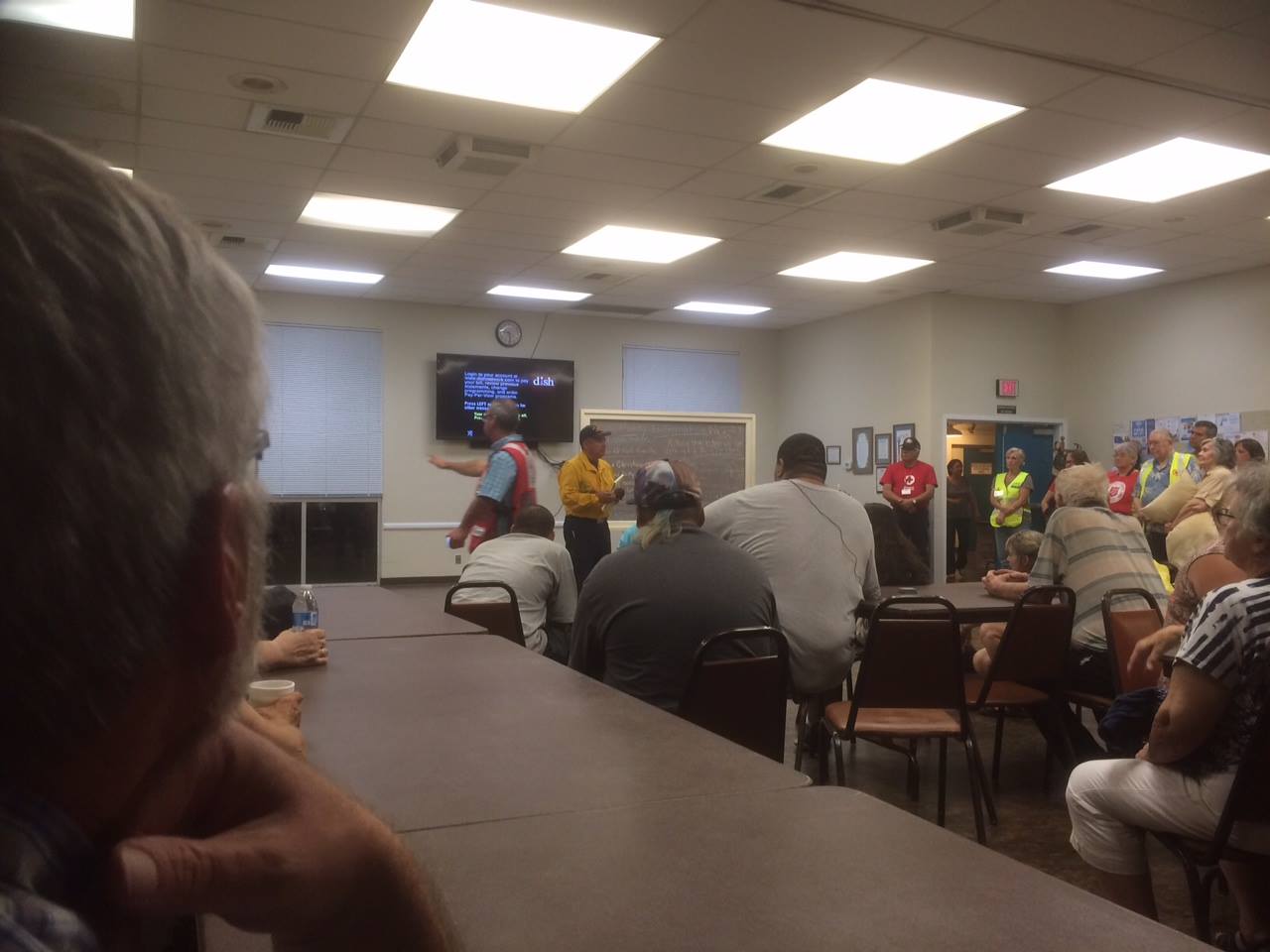
    Later that evening we went to the Red Cross shelter at the Senior Center in Lake Isabella for the latest news about the fire. We learned the situation was terrible. Two people had died in their driveway from smoke inhalation on McCray just a few houses from where I was picked up. The fire was out of control, and dozens of homes had already burned to the ground; there would be more, many more.

    I talked with a friend who was sitting with her children. They had lost everything and had only minutes to escape. We saw one of Liz’s friends, Alex. He said his dad’s house was gone, and he couldn’t find his dad. (That was the location where Amber was loaded into the horse trailer, only the house was untouched at the time.) The Red Cross shelter was getting crowded as more evacuees arrived, many with their pets. Scanning the crowd, I looked for my neighbor and Hernia Dog.

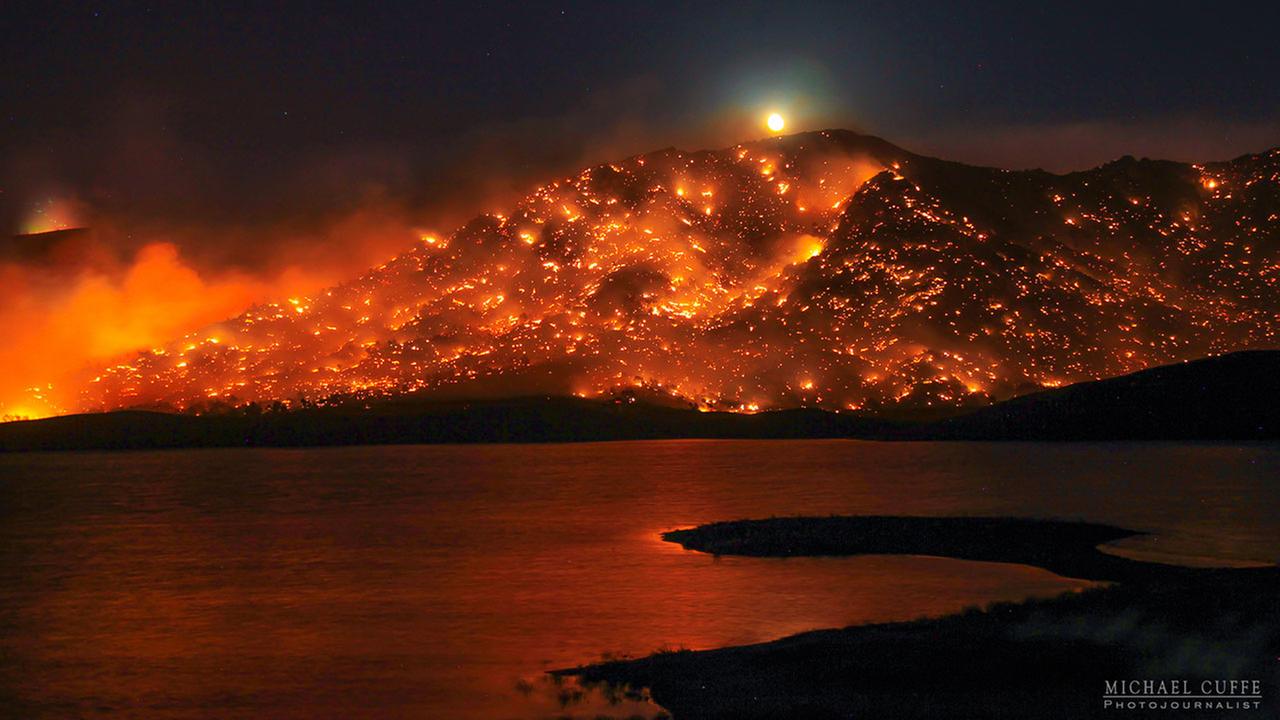
    After the meeting, we drove back to Wofford Heights. Looking across the lake toward Squirrel Valley, the mountains glowed red. The fire had already burned through Cook Peak mountain, Squirrel Valley, Mt. Mesa, Southlake and Weldon and was heading east with 0% containment.
    1400669_1280x720

    Photojournalist Michael Cuffe, captured the horror of that night. 

    The next morning we went to Kernville, so I could call my clients and let them know what had happened. Kernville Elementary School was a Red Cross shelter location, and it was packed with evacuees, volunteers, fire officials and insurance representatives. We found a quiet spot under a mulberry tree and waited for the news briefing at 10:00 a.m., hoping to learn when we could return to our home and if it were still there. Not knowing was torture and so was ruminating over the fate of my animals.
    13568937_10210028942779299_5241642922112556076_o

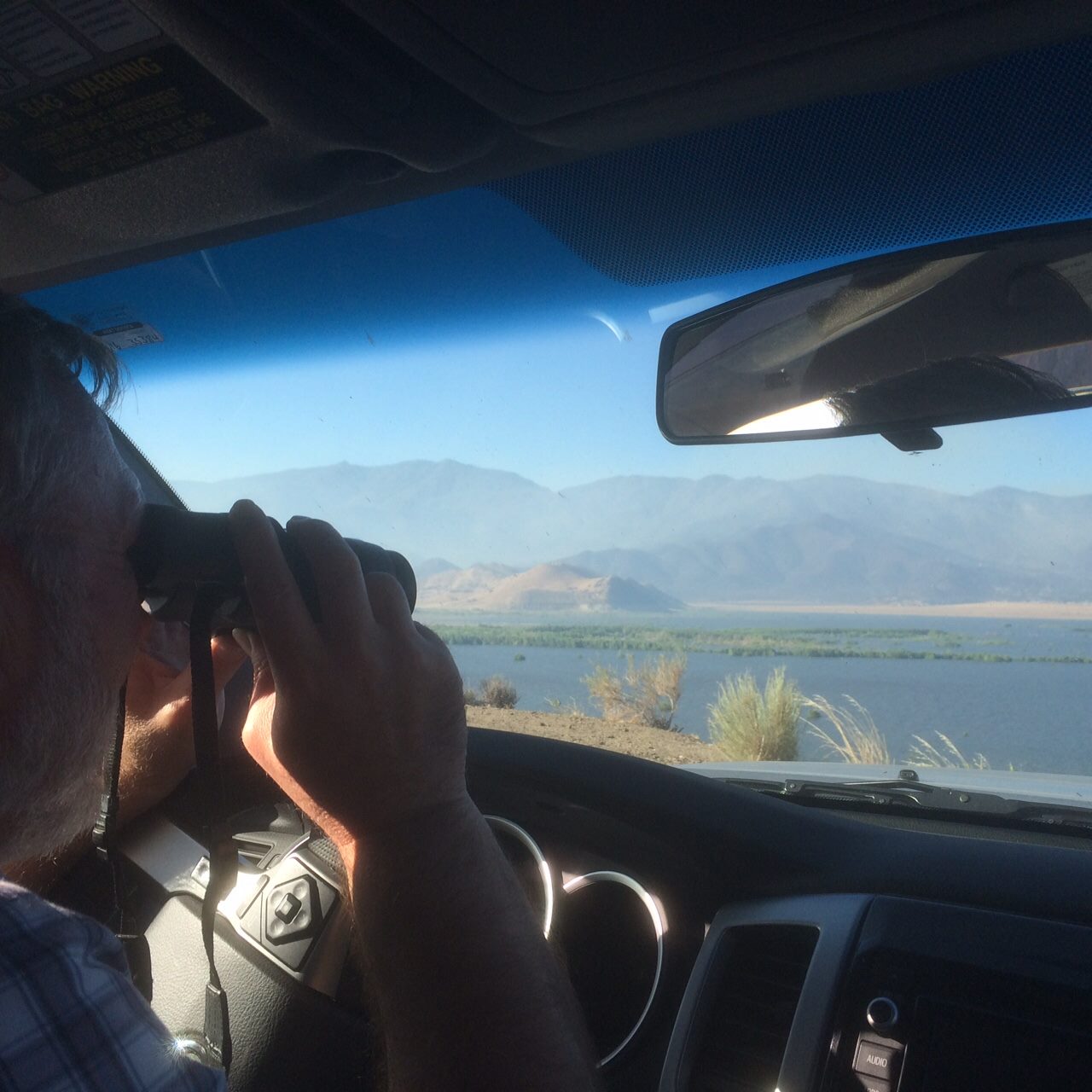
    We borrowed binoculars and drove around to the backside of the lake, but it was too far to see if Cook Peak was alive. We saw a lot of burned areas and no traffic on the highway which meant the area was still sealed off to the public. It was weird how in the morning it looked like the fire was almost out which gave us a false sense that the situation was almost over. As the day heated up into the upper nineties, so did the fire.

    250+ homes and 48,000 acres were destroyed over the next few days, and the entire Kern River Valley was enveloped in smoke. The Erskine Creek Fire would later become Kern County’s most destructive fire.
    13559143_10210028942859301_8990772058685435440_o

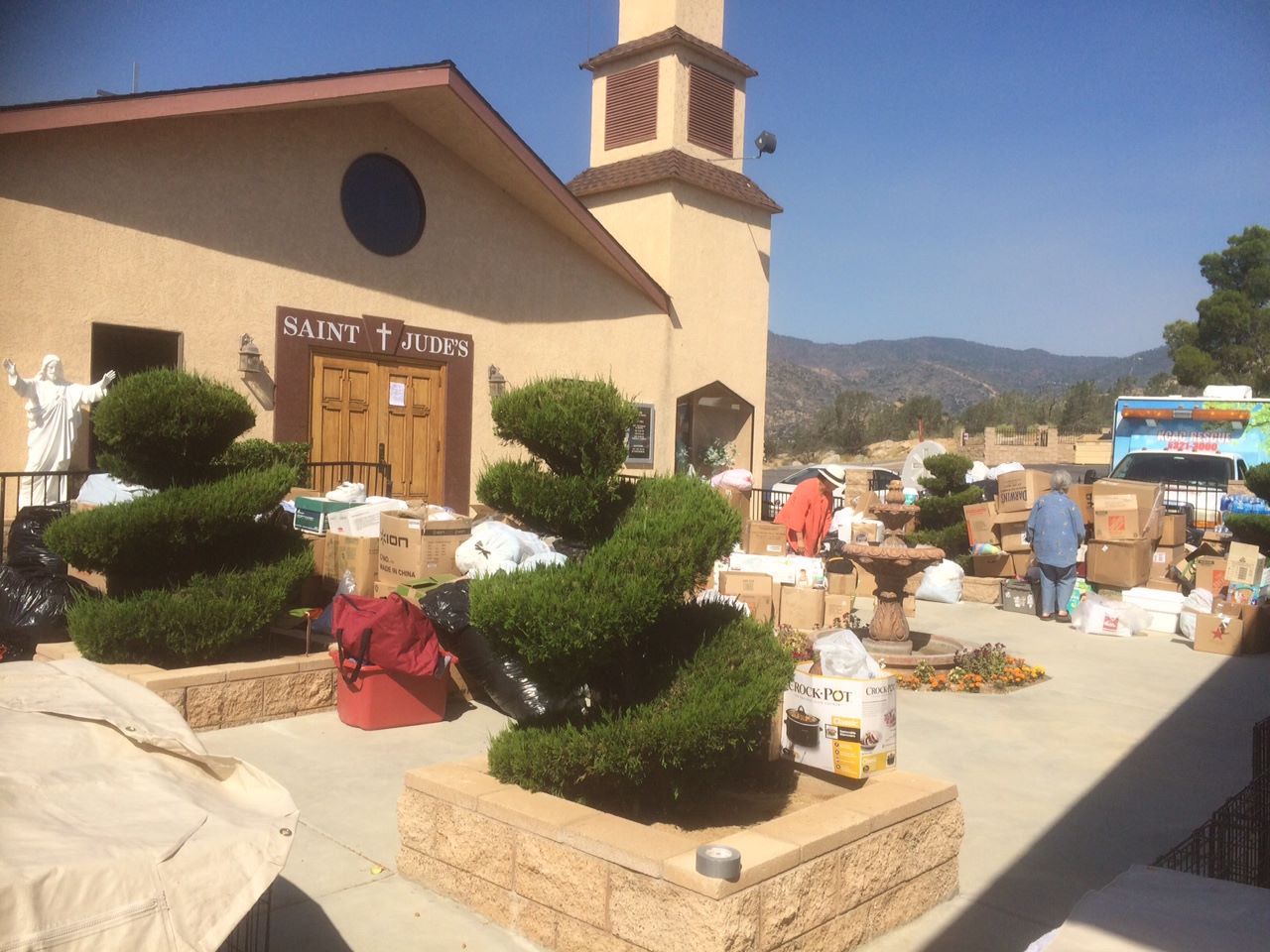
    St. Judes Catholic Church also became one of the Red Cross evacuation centers. My mother-in-law is the church secretary. Donations poured in faster than anyone could process. It felt good knowing people, random people from all over Kern County and beyond, had rallied together to send help our way. When I left Cook Peak with Amber, I only had the clothes on my back and my cell phone. As a fire survivor, I was allowed to pick out a new toothbrush from a box filled with hundreds of toothbrushes and anything else I needed. 4H groups brought in truckloads of hay and feed to the valley for displaced livestock. Animal shelters in other cities brought food and supplies.
    13613512_10210028943579319_7384316095486134190_o

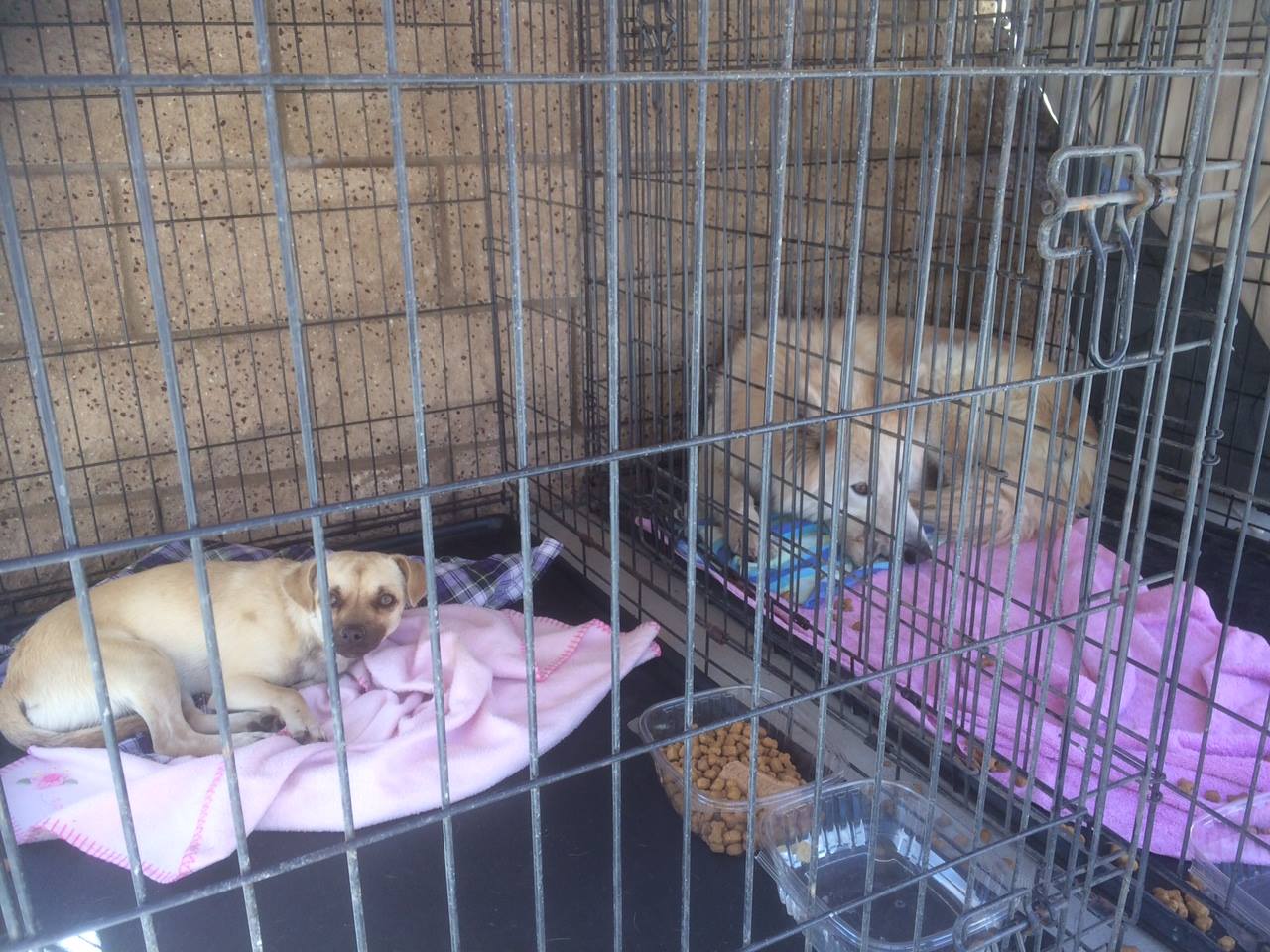
    Animal Control was in charge of all the displaced animals. Over the next few days, they went into the burned areas and rounded up lost dogs and cats. They fed livestock and dropped off pet food to the people who chose not to evacuate. Many of the evacuees at the Red Cross shelters brought their pets with them. Animal Control gave them cages and carriers and pet food to help them. These two dogs were at St. Judes, waiting to be claimed by their owners. We checked all the cages daily for Hernia Dog.
    13575925_10210028943459316_5418281264407791768_o

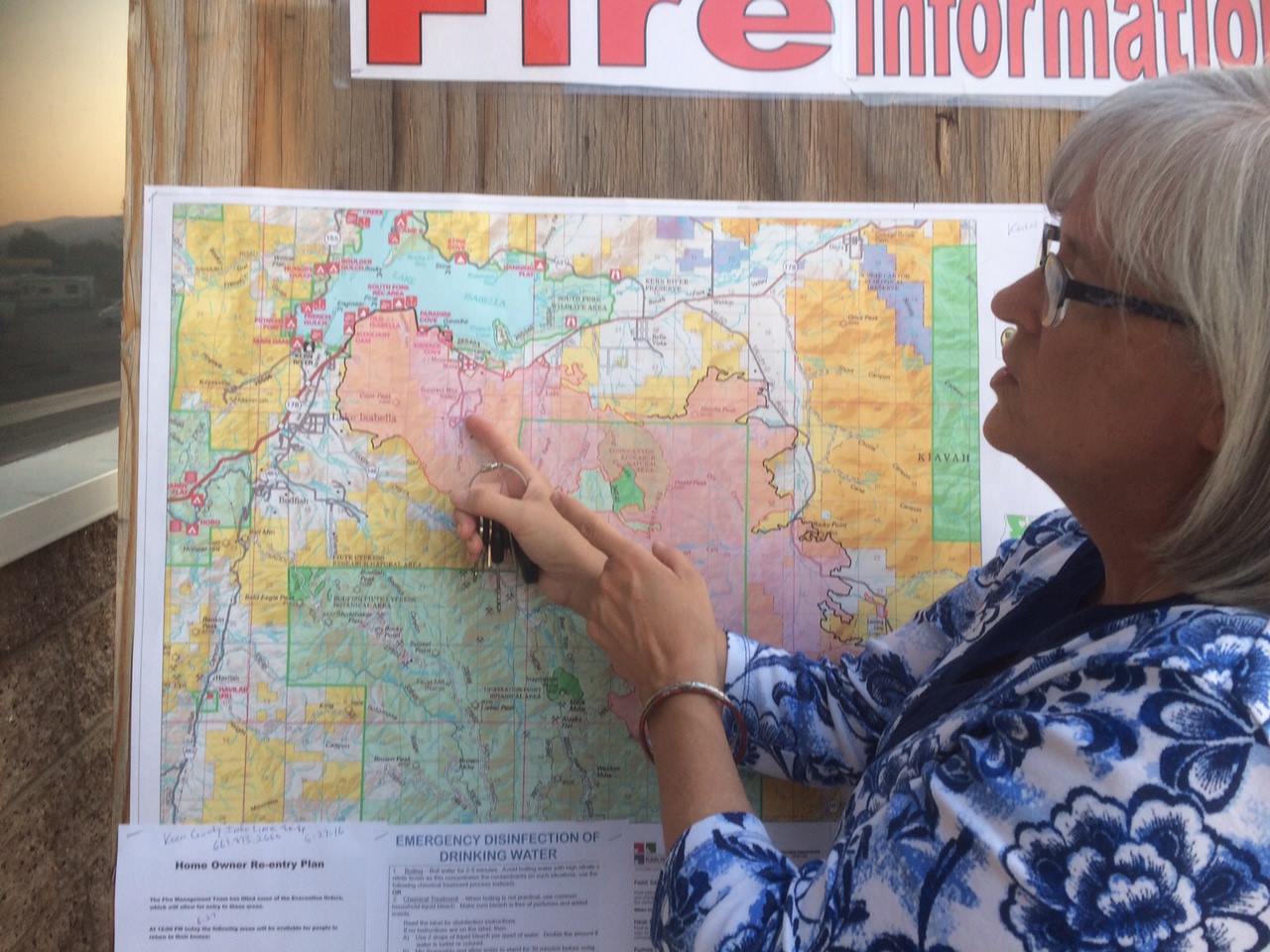
    Here I am at our local Vons, pointing out where Cook Peak was in the midst of the red fire zone. When news reached us through friends that Cook Peak survived the fire, and the pigs and chickens were alive, we felt some relief, but the anxiety continued. Police had all the burned areas sealed off to the public, and the public was getting angry. David found a way in. He had a friend with a press pass, and the two of them were granted access to the disaster area.

    Thankfully Cook Peak survived the fire with relatively minor damage. Many of our neighbors lost everything. David retrieved my computer equipment and found Hernia Dog! Yes, Hernia Dog. My neighbor across the street had stayed behind and helped save Cook Peak from burning with a garden hose.

    By Monday morning, Hernia Dog and I were in the Deacon’s office at St. Judes, and Ann Cook Design was back in business. It was difficult to concentrate on work when we were on such an emotional rollercoaster.

    The worst area hit by the fire was Southlake. 200+ mobile homes were incinerated, and hundreds of the people were displaced. That’s when I experienced a strange feeling. Over the next few days, I met people who lost everything and listened to their stories. I began to feel guilty because my home survived. Why? Why was Cook Peak spared?
    13558714_10210028943379314_7253300448008318825_o

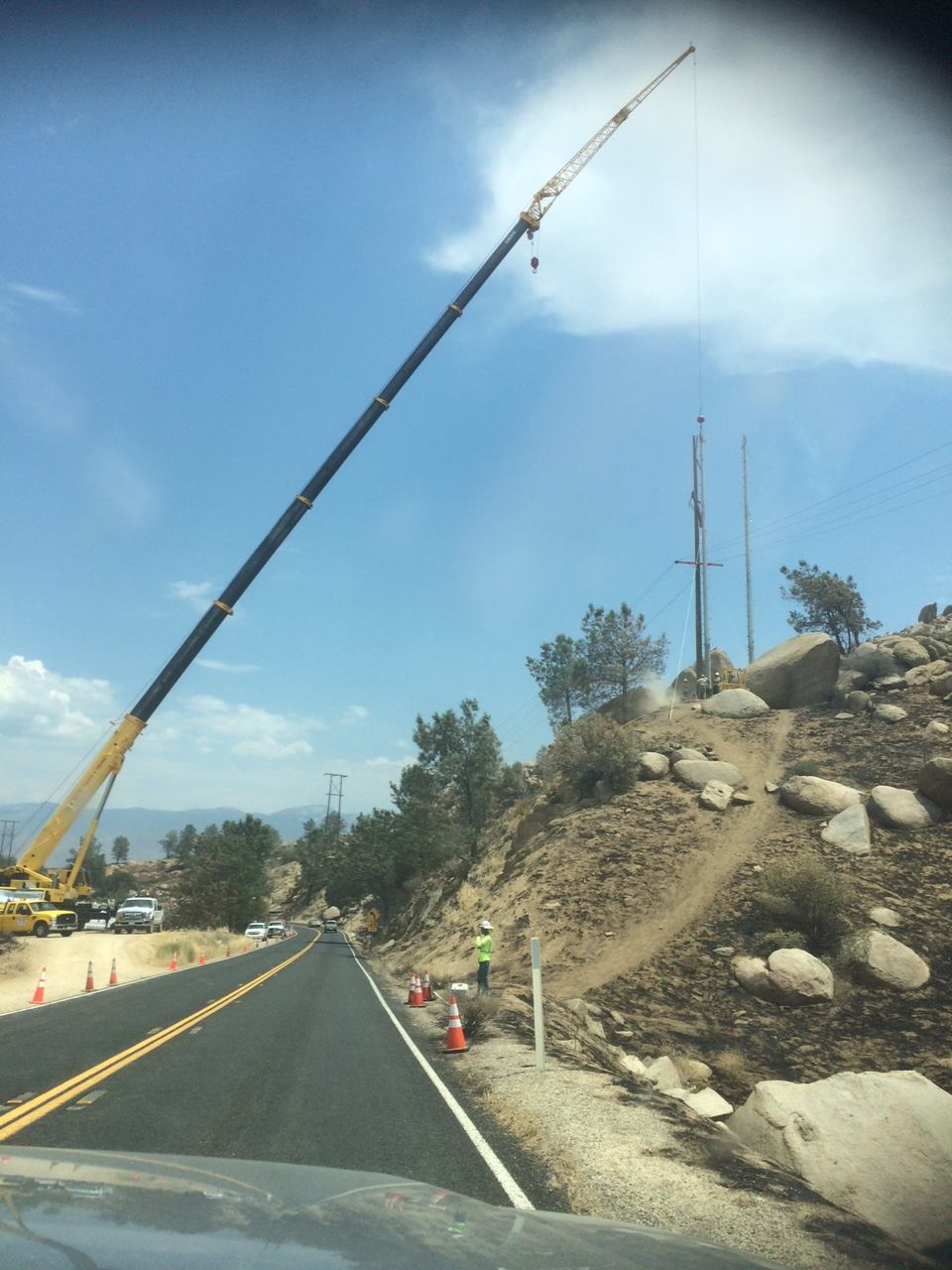
    A week after the fire we were allowed to return to Cook Peak. The electricity was still out, but the mandatory boiling of water had lifted. The fire burned all the main electrical poles from Lake Isabella to Southlake, and South California Edison worked around-the-clock to rebuild and restore power. Here are the workmen putting in new poles with a giant crane! People honked and waved at them as if they were celebrities.
    13580451_10210028944779349_3444058406782049097_o

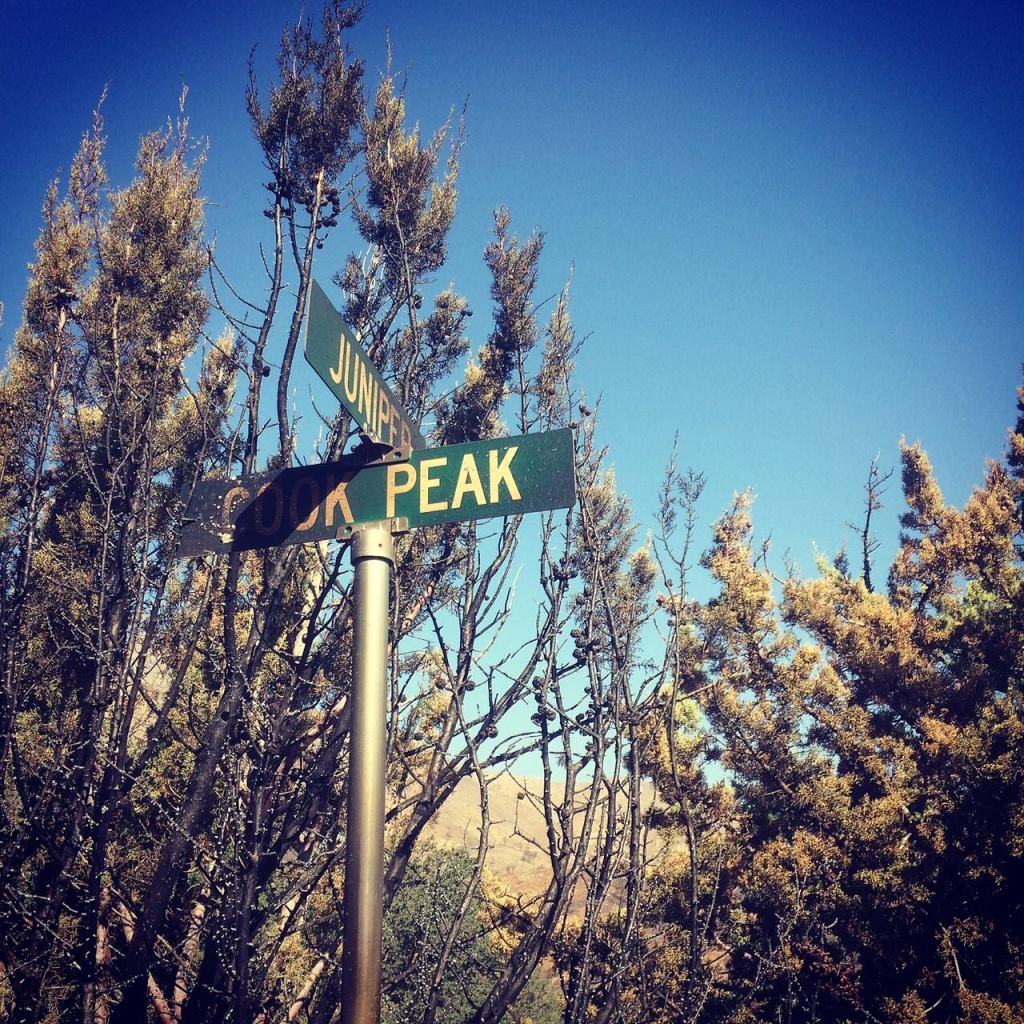
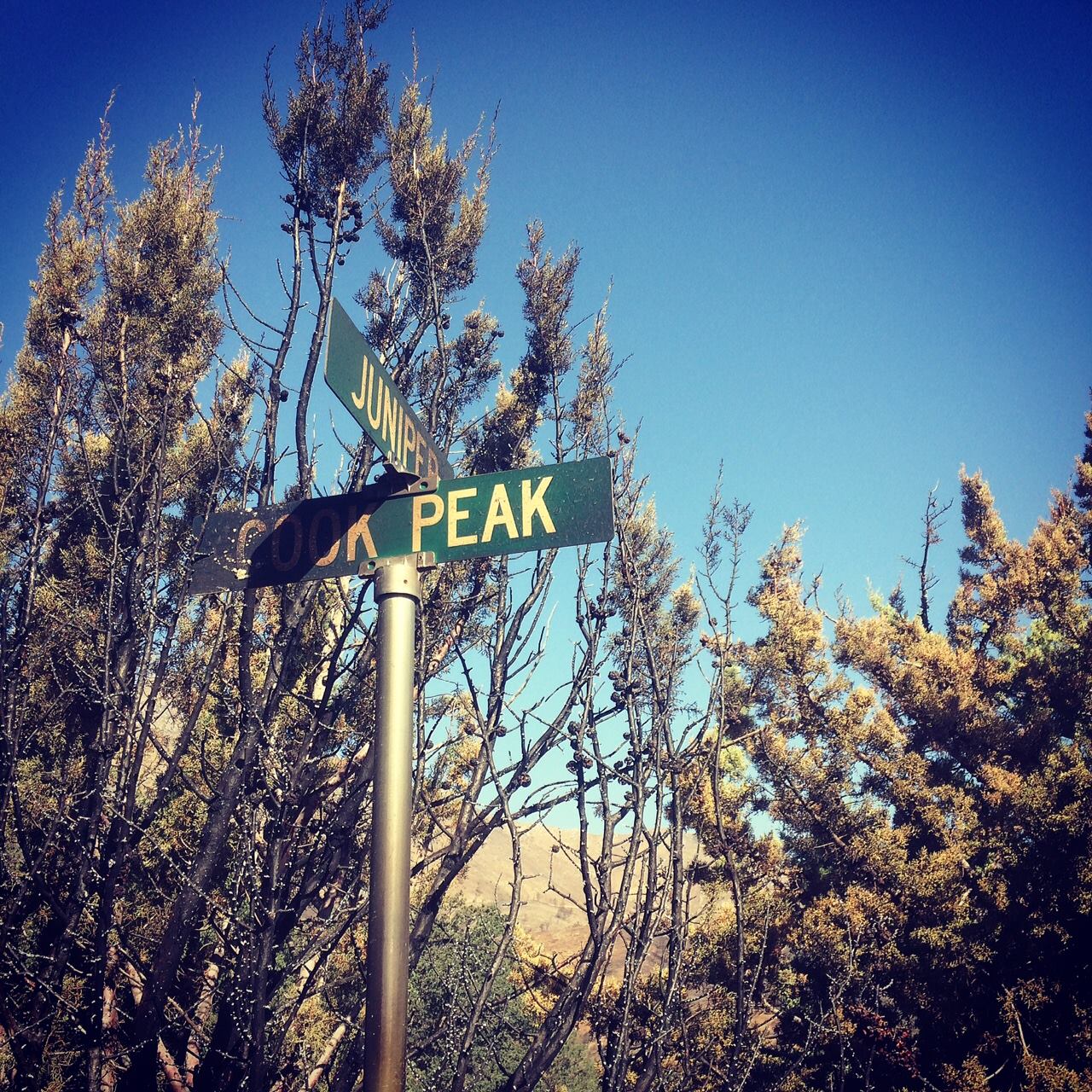
    Here’s one of the street signs a block from our house. Those are Juniper trees behind the sign. When we moved to Cook Peak, the house was surrounded on three sides by Juniper trees like a privacy fence. We cut them all down the first year, and it’s a good thing we did! They’re a fire hazard, and we would have lost everything.

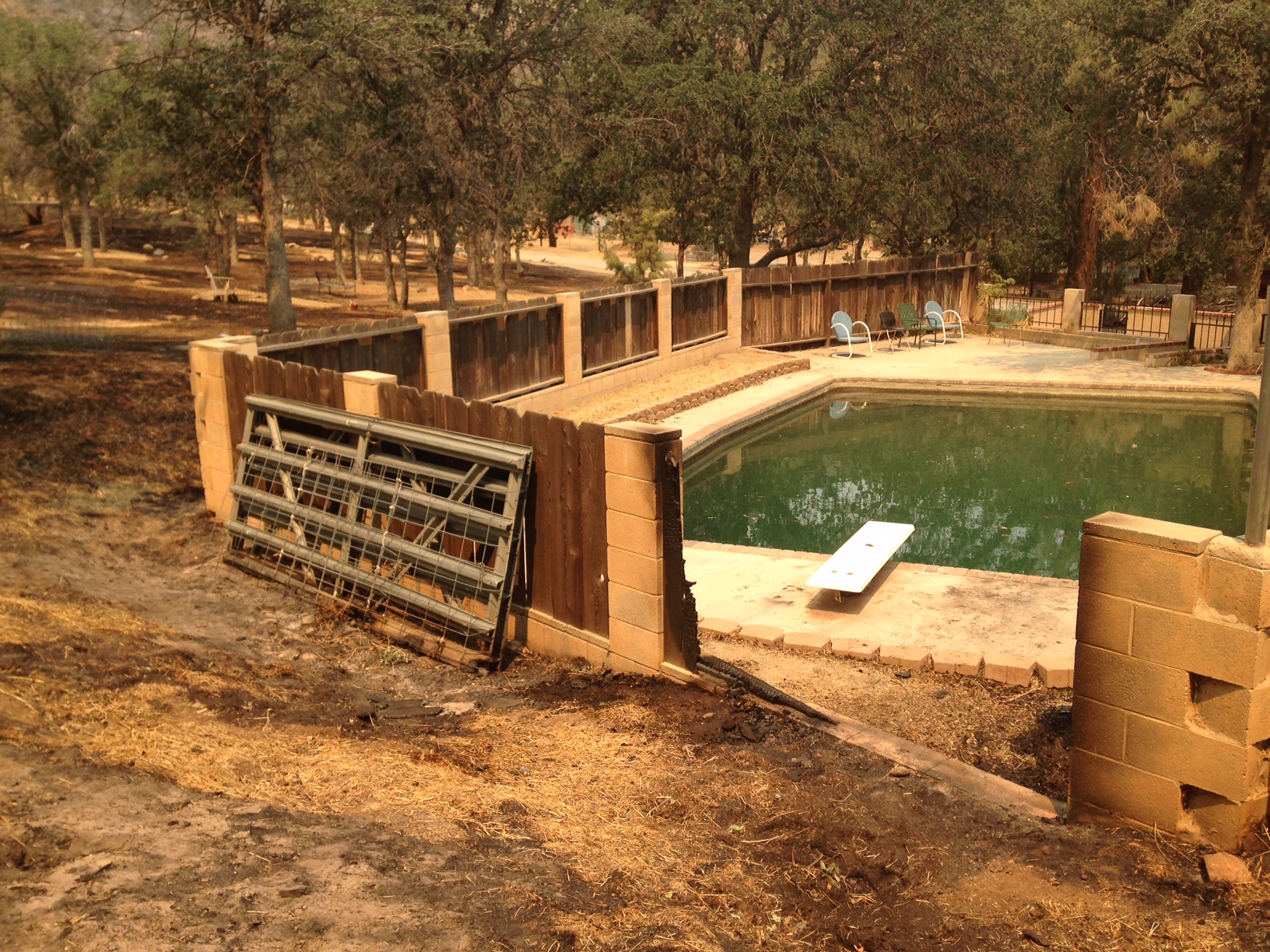
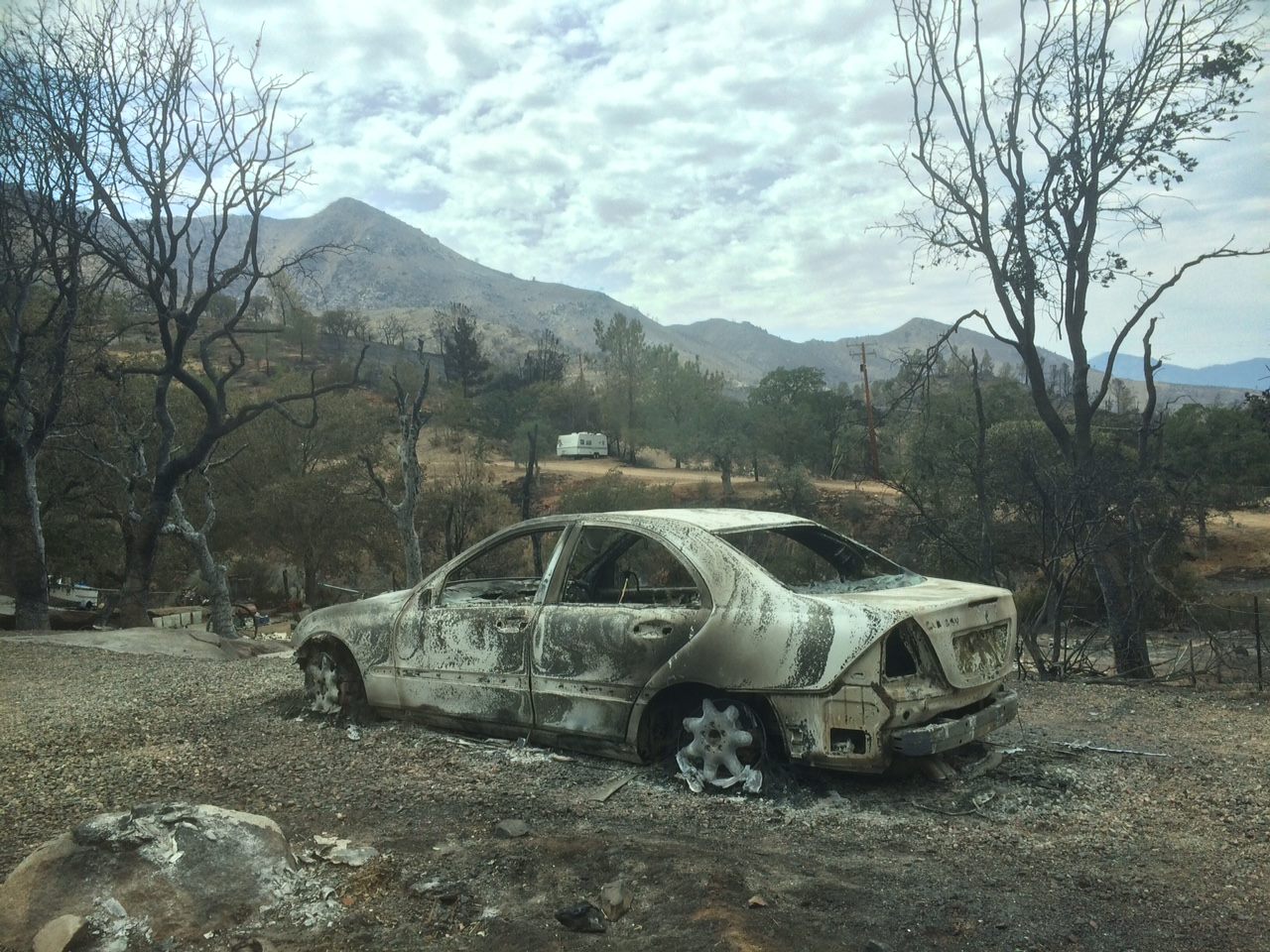
    The fire was officially over. The physical damage was minor, but the stress of it all made us feel like we were going to stroke out. We could fix things like the cement pond. It was a vast, toxic mess and the filter/plumbing was ruined, but we could bring it back to life. The horse fences had burned down, and the pasture and our lot next door were blackened. We fared better than we expected and felt guilty for being lucky.

    One thing I will always remember about the fire was the smell when I opened the front door for the first time. It took my breath away. It smelled like a stale ashtray or a campfire minus the hotdogs. Ash was on everything and in everything. Because the windows were open when I evacuated, the was an overwhelming mess to clean up.
    13613113_10210028944619345_701816643790612528_o

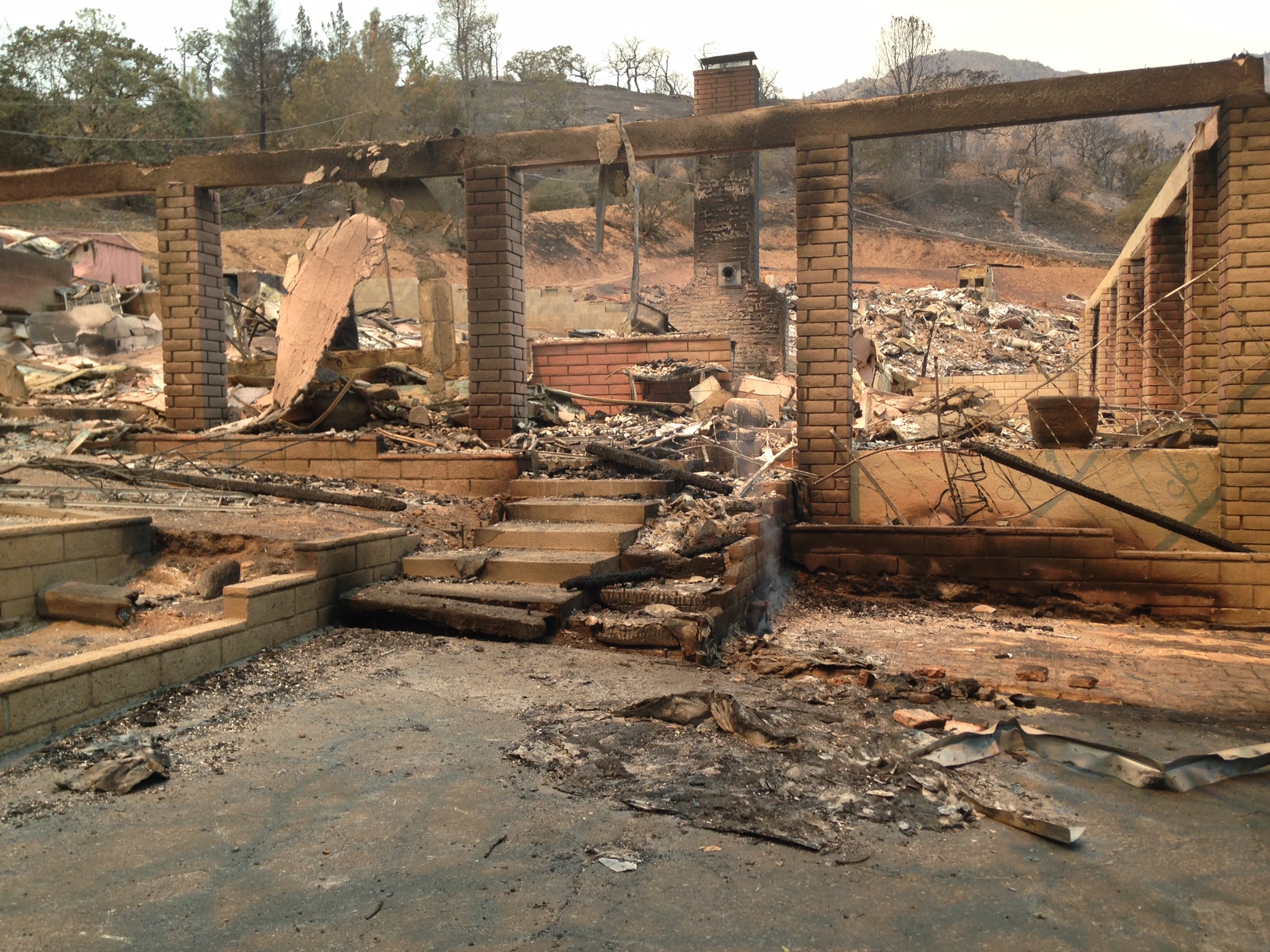
    We toured the neighborhood over the next few days like everyone else. The devastation was a sobering experience. When the girls lived at home, we’d go on walks around the neighborhood, especially in the evenings with Hernia Dog. We knew every house, and now many of them were gone.
    IMG_4410

    13585176_10210028944819350_3505755394784981885_o

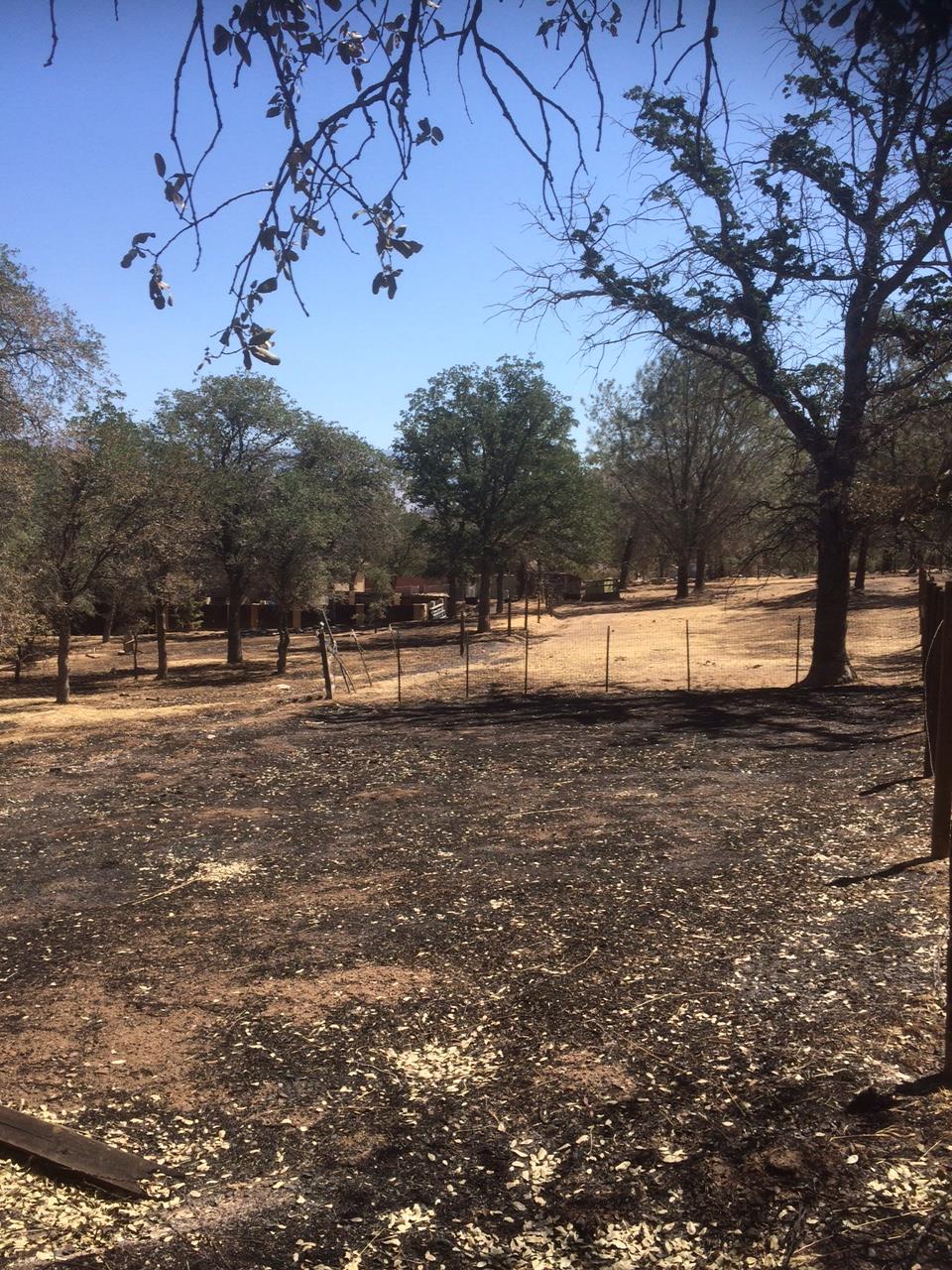
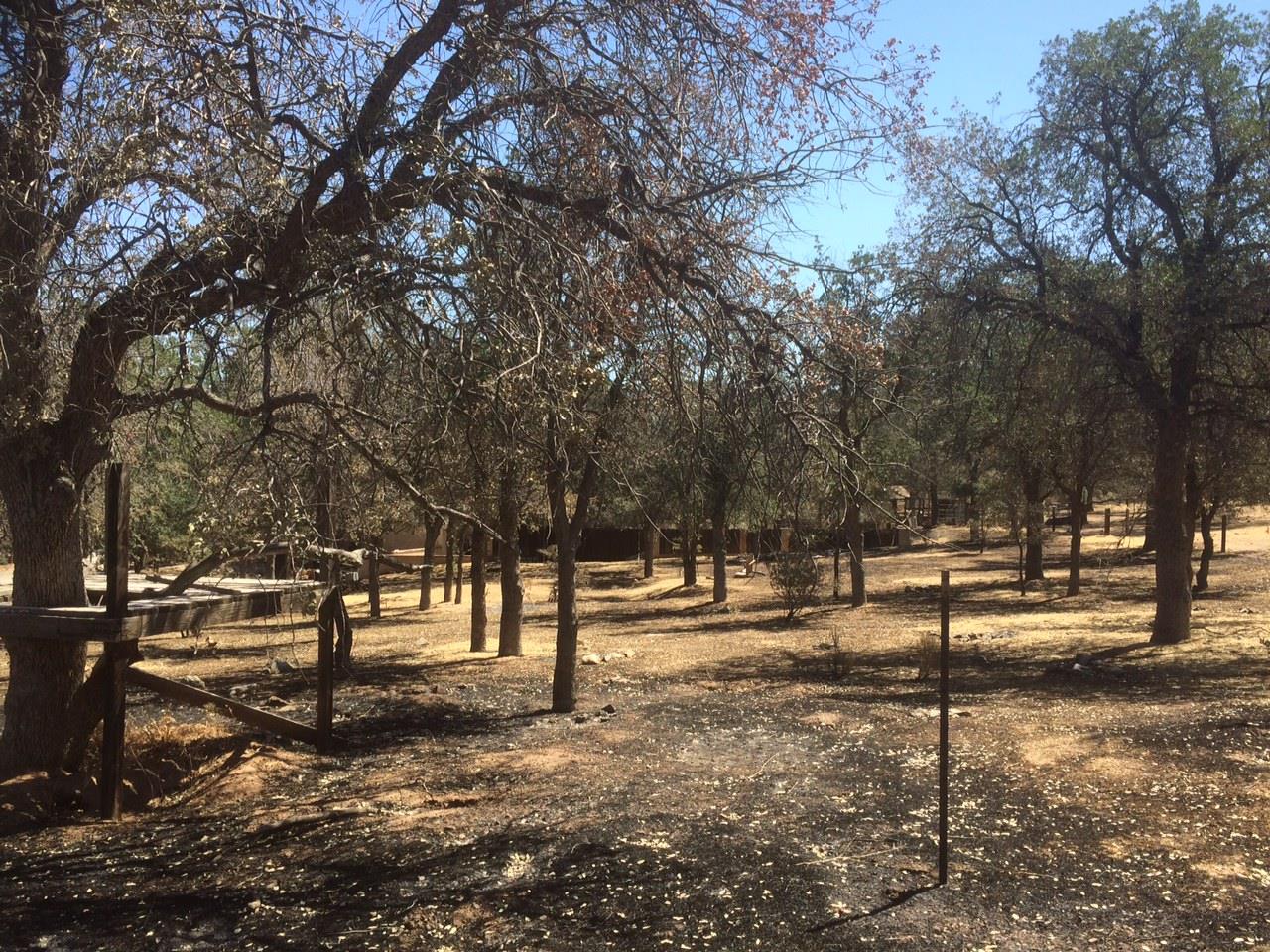
    In this picture, I’m standing in the back pasture looking toward Cook Peak. In the background, you can see the fence around the cement pond, and to the right, the barnyard area. I often found myself fixated on the burned areas in an unhealthy way. I’d go out the back and step through the burned out pool fence to get to the burned pasture and look at all the burned areas. It’s going to take a while for the land to heal. We lost some of the oak trees in the side yard, but mostly the ground was scorched.
    13576845_10210028945379364_6614819413000359036_o

    To combat our gloominess, we planted flowers in the front yard. If I looked out my front window, I could not tell there had been a devastating fire around me. But if I looked out my back window, all I saw was burned, and it wasn’t healthy for me. With the fire behind us, our goal was clean and fix everything and to get back to normal as soon as possible.
    13613459_10210028945459366_1192765126082533002_o

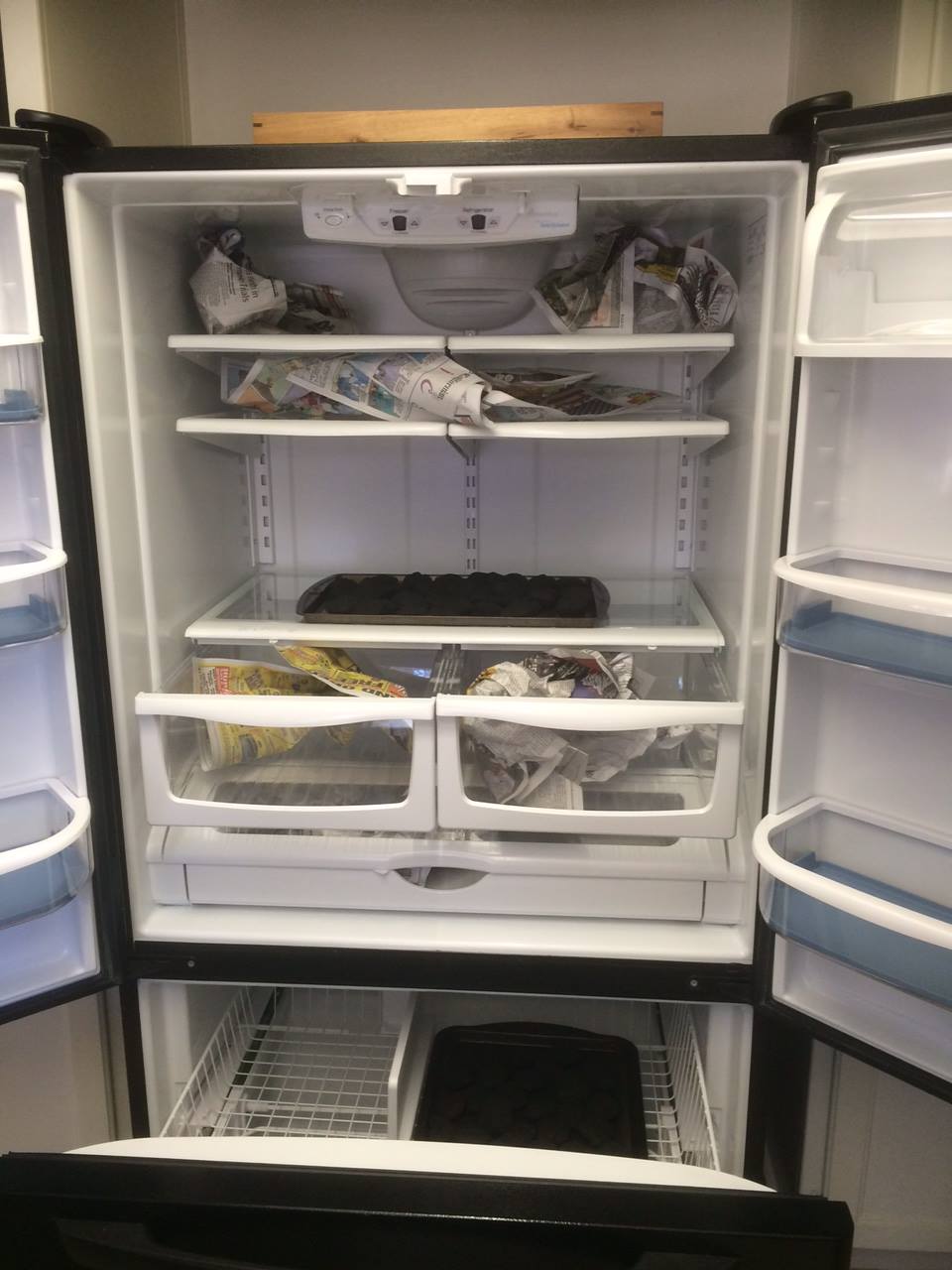
    When you’re in a fire, and your fridge stays closed for many days in the hot summer without power, it turns into a stinking box. We cleaned ours thoroughly, but the stench was overwhelming. We Googled and found a home remedy of charcoal briquettes on cookie sheets and wads of The Bakersfield Californian to help absorb the odor. That didn’t work out very well. After living out of an ice chest for a couple of days, insurance agreed we had a refrigerator problem and brought us a new fridge, and it’s a beauty! The stink box went to the landfill.
    13603238_10210028945699372_8441330614140135198_o

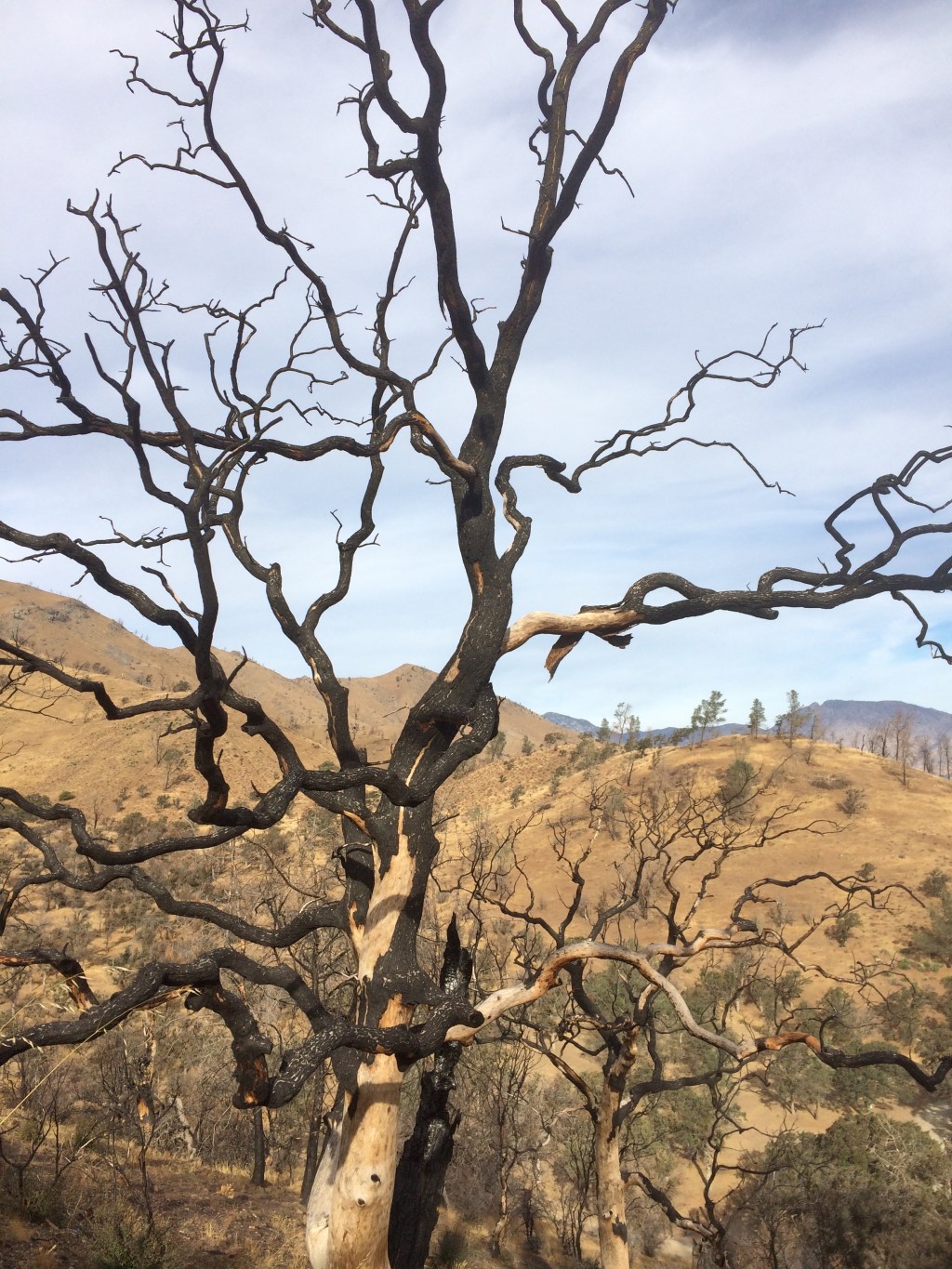
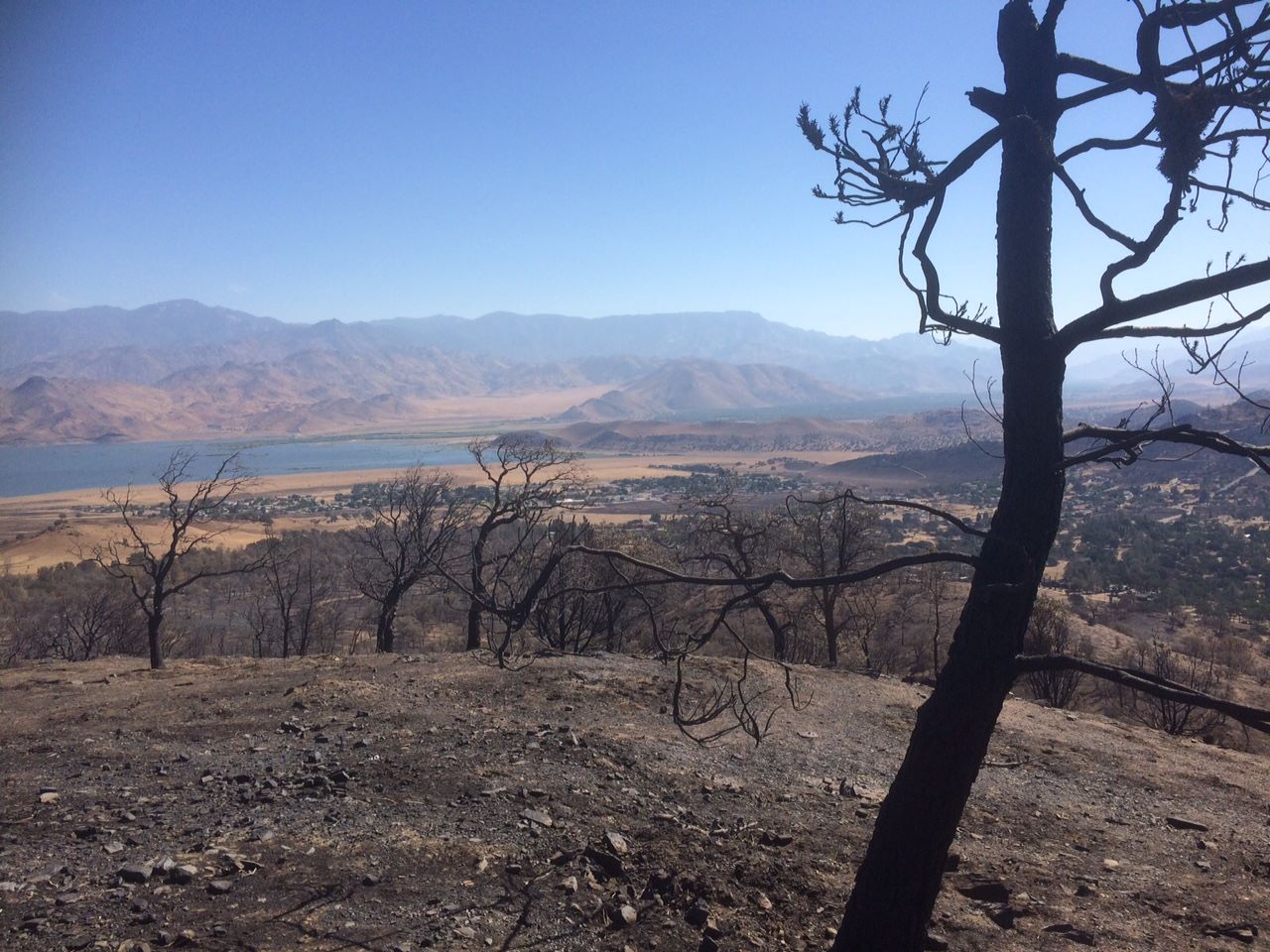
    David and I drove up the road to Cook Peak mountain a few days after the fire and stopped at the flat spot. The view was spectacular as usual yet this time sobering as we looked down upon Squirrel Valley. The fire’s path of destruction was obvious and we could see how it went around Cook Peak. It was strange to see the trees on the flat spot black like matchsticks, as the ash swirled around us.

    It’s been three weeks since the fire. Our house smells normal, or maybe we’re just used to it. The Red Cross is gone, and hand-outs have stopped. The fire trucks no longer cruise neighborhood every day to check for hotspots. The strangest time is the night. It’s darker than usual without neighbors behind us and the wildlife is gone.


    We are coming up on the two year anniversary of the Erskine Creek Fire in June. It’s also the beginning of the 2018 fire season. I can’t help but feel anxious, but I hear that’s normal. I’m okay with that.
  • The Bear

    The wildest animal I encountered in the city was a desert tortoise. It belonged to the neighbor at the end of our street and went missing after digging a hole under their backyard fence. We discovered it crawling up our driveway toward our open garage.

    There were plenty of wild creatures on our cul-de-sac. We lived among the sparrows, robins, butterflies, and wasps. There were hummingbirds and honeybees, garden toads and snails. Occasionally a large bird circled above but rarely swooped low enough to identify its species. We were conservationists, helping nature by raising orphaned birds and saving earthworms from dehydrating on the sidewalk.

    We found a fresh, dark mound of half-digested berries in our gravel driveway the day we moved to Cook Peak. After comparing images from the Internet, we concluded it was bear skat. I was giddy. I took photographs, determined to show our city friends that we lived where the wild animals are.

    The previous owner warned us about the local wildlife around Cook Peak. She seemed to enjoy our nervous reaction a little too much. It did not take long to get acquainted with the local deer, raccoons, bobcats, coyotes, mountain lion, bears, Ravens, red-tailed hawks, Turkey Vultures, rattlesnakes, and tarantulas. The scary ones prowled at night and rarely did we see them, but we knew they were out there by their skat. Coyotes were the most vocal bunch, screaming in the pasture on a full moon while hunting jackrabbits. In the side yard, we caught raccoons as big as Labradors with our flashlight beams and watched them saunter into the night as if we’d interrupted their leisure. Personally, I was glad the rattlesnakes were reclusive, at least in our yard, unlike the tarantulas that climbed the stucco to escape a summer downpour. We had a healthy respect for the wildlife and were careful not to interact, especially after dark. We knew what lurked beyond the fence line.

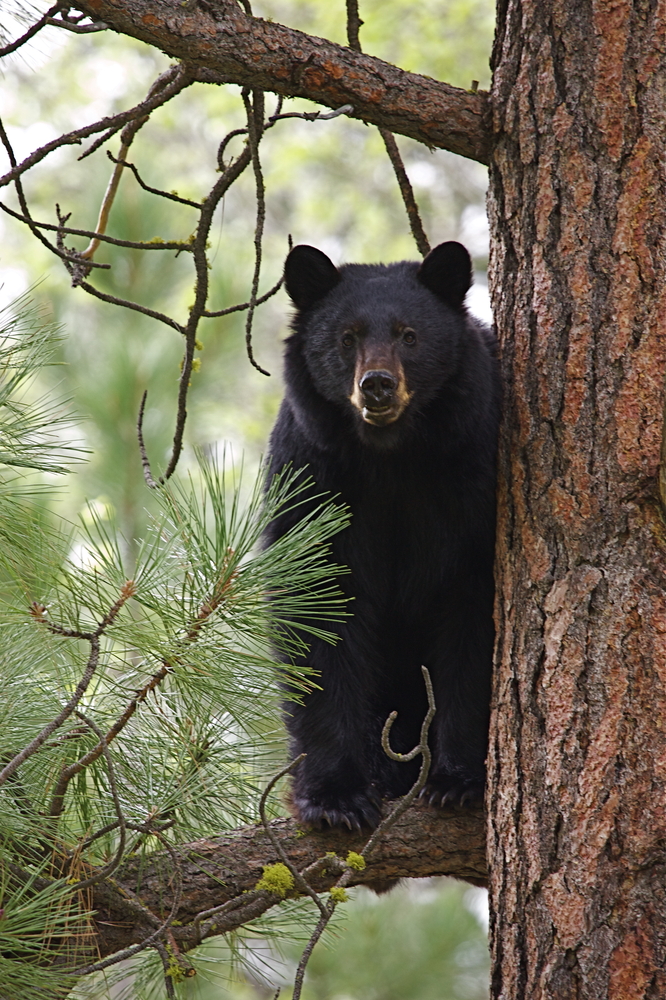
    The bear was a regular at Cook Peak on hot summer nights. We knew when he was outside because the fur on Hernia Dog’s back stood straight and he growled a low, steady rumble. There were no porch lights, motion detectors or landscape lighting on that side of the house, only the moonlight and the bear eating our garbage.

    Most nights the bear toppled our trashcans. He pulled the plastic bags out and dragged them into the lot next door to forage and defecate. In the mornings, I cleaned up his mess while complaining about the Ravens and the wind making it harder to round up debris, strewn all the way down the street. My worst day was trash day when the sanitation worker came before dawn. If the bear pillaged the night before, there was a huge mess and little time for cleanup. They did not like to wait for me and sent a notice in the mail complaining about it. I had to find a way to keep my trashcans safe from the bear or risk losing my service.

    We sinched the cans to the oak trees. We tied wind chimes and strapped Bungie-cords to the lids. We put the trashcans in our backyard behind the gate. We tried camouflage and doused the cans with vinegar. The only thing that worked was keeping bear-worthy garbage inside the house and only taking it out at dawn on garbage day.

    I didn’t mind that there was a bear at Cook Peak. I had wished for years for night vision goggles so I could watch him. Mostly I was content straining to see his shadow from the upstairs bathroom window, but when he began showing up during the day, that was exciting.

    A frantic neighbor came to my door around noon. They saw the bear drinking from the trough in my barnyard and wanted to warn me. I already knew. That year was a drought year, and the bear was searching for water. Often he drank from my bird bath in the side yard and didn’t seem worried as we watched through the sliding glass door. Weeks later another neighbor called to tell us the bear was in a tree, and we should come and see it, and of course, we did, but it wasn’t our bear; it was a terrified youngster treed by a crowd of lookie-loos. Once they dispersed, the bear came down and ran to the ravine. On several occasions, while coming home late at night, the bear was in my front yard. At first, I waited for him to leave because the distance from my truck to the front door was too far to make a run for it. But over time, I merely told the bear to go home and walked to the front door with confidence. He never bothered me, just my garbage.

    After the Erskine Creek Fire in 2106, the bear disappeared. I wondered if he had died in the fire, fled to the high country or if someone shot him for living too close to humans.

    I take the trash out like everyone else, now. There’s no drama. Part of me hopes and waits for that one special day when I wake up in the morning and find my trashcans on their side. If that were to happen, I’d gladly clean up the mess and whisper; I’m glad you’re back. I missed you.

    This slideshow requires JavaScript.

  • Sheldon

    Sheldon was The Cat of Cook Peak. We rescued him from Hart Park in Bakersfield on a hot July evening at dusk. Often we took the scenic route home through the park, hoping to see the peacocks roaming alongside the road. Near the old train bridge, there was an enormous clutter of cats. Among them were raccoons, skunks, and a chihuahua all waiting for the do-gooders who arrived each night to feed them. We parked, got out and watched the show.

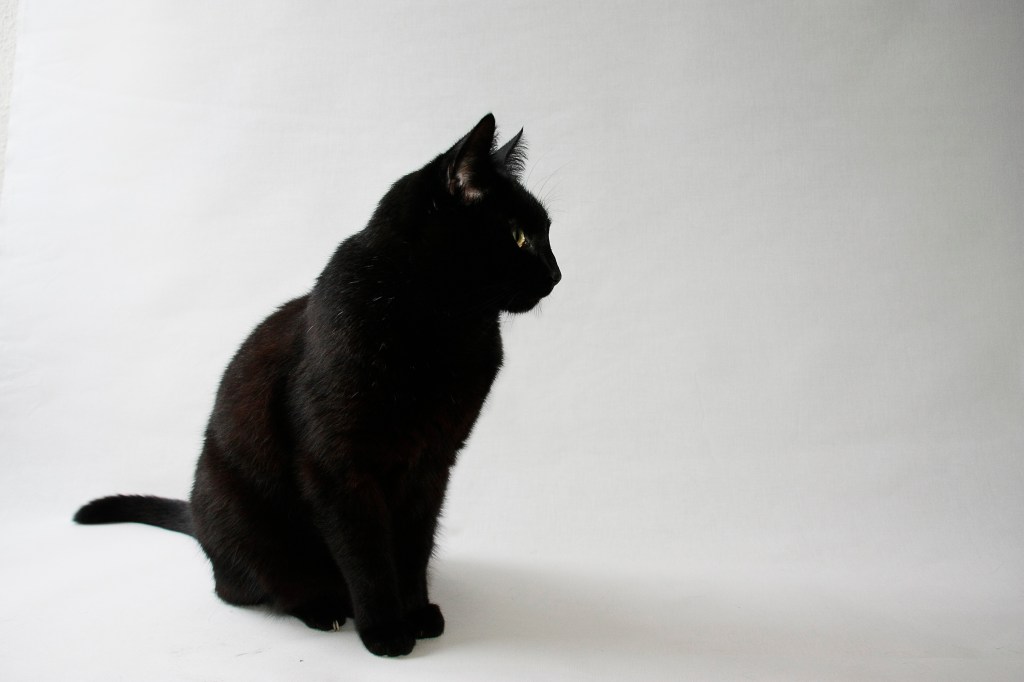
    Sheldon was a young high tailer, a perky black, and white cat, only a few months old, with a Hitler-style mustache. From the very beginning, he bonded with David, the weakest link, and jumped into his arms. He was a friendly cat, but he had a chronic skin condition, which was probably the reason for his abandonment, but his personality made up for his scraggly appearance. We put him in our truck and drove home, calming his nerves by singing the “Soft Kitty” song from The Big Bang Theory. That’s how he got his name, Sheldon.

    Sheldon was a love machine. He over-compensated for being a mangy orphan by rubbing his body all over us and jumping onto our laps for scratches under his chin and lots of petting, which probably felt good with his skin condition. Those first nights he slept near our faces and crawled under the covers by our feet, and we let him. We were all in love.

    Sheldon’s first trip to the vet was eye-opening. Dr. Lange took one look at Sheldon and said, “That’s not mange! That cat has chronic ringworm on 75% of his body!” He put on rubber gloves and turned on a black light. While Sheldon purred, he glowed brighter than a 1960s blacklight poster. And so would we a few days later.

    Dr. Lange strongly advised euthanizing Sheldon. He did not think we could follow the strict regimen of treatments necessary to save his life. David and I looked at each other. After rescuing Sheldon from Hart Park and giving him a family to love, we were not going to end his life like that. We told Dr. Lange we were prepared to fight for Sheldon. He shook his head and said good luck with that.

    It was a grueling 9-week regimen of treatments. Weekly sulfur baths for Sheldon made him stink like rotten eggs, and his white fur turned yellow. We forced anti-fungal pills down his throat twice a day. The rest of the family went to a doctor and were prescribed weeks of anti-fungal medications, both internal and external. Small spots had begun forming into rings, but the itch was bearable at first. But when the swamp cooler broke during a 100-degree spell, every ring on our bodies from head to toe bloomed bright red and itched beyond description.

    Sheldon lived his nine weeks in quarantine in the downstairs bathroom inside a wire cage. Twice a day David put on hazmat gear and visited for an hour. With rubber gloves on, he cuddled and played with Sheldon, while the rest of us watched from a safe distance through the window. Meanwhile, Cook Peak was contaminated. Every day we deep cleaned, washed and bleached everything only to wake up the next day and do it all over again. Even the carpet was removed. We put a giant wire cage in the corner of the living room for Hernia Dog. He’d developed spots, too and had to be bathed in sulfur, medicated and quarantined. It took nine weeks of isolation of family and pets to kill the plague of Cook Peak. When it was all over, our experience had brought us closer together as a family. Not only had we gained an exceptional cat, but also earned the respect of our veterinarian.

    A young red tabby, about the age of Sheldon, showed up during the fall and wouldn’t leave. Sheldon was strictly an indoor cat at the time, but the two of them were inseparable with only a quarter of an inch of glass between them. We named the newcomer Mr. Leonard and tried to ignore him, but eventually, we invited him in.

    I began to photograph Sheldon, capturing his quirky personality and the contrast of his black and white fur. I created a Facebook page about him and wrote posts from his perspective and uploaded my photos. Sheldon became famous overnight. He was Batman. Mr. Leonard was Robin, and life was good in Gotham.

    One evening at dusk, Sheldon didn’t come inside when we called. He wasn’t one to go far or stay out late or be apart from Mr. Leonard. I felt sick in my stomach as I searched the property with a flashlight, looking for a body. Coyotes had been at Cook Peak earlier that day, The Bear, too. Once we caught Sheldon and The Bear at the birdbath in the side yard touching noses; Sheldon didn’t flinch. He wasn’t afraid of coyotes either. To him, they were like Hernia Dog and dogs didn’t worry him at all. Sheldon’s disappearance was devastating for all of us. After everything we’d gone through to save his life, Sheldon had disappeared.

    Sheldon’s Facebook page still gets likes from around the world. Sometimes I go to his wall and browse through old posts and photos, and it feels like a memorial. Unfortunately, Mr. Leonard is not as photogenic, but he has turned out to be an exceptional indoor cat. He is no Sheldon, but he has filled the void in our hearts and has become The Cat of Cook Peak.


    Photos of Sheldon

    This slideshow requires JavaScript.


    The Adventures of Sheldon

    This slideshow requires JavaScript.

    https://www.facebook.com/sheldonthecat2014/

    “Like” Sheldon


  • Hernia Dog

    His name is Luke, but I call him Hernia Dog.

    When Luke was a puppy, he had a hernia that protruded from his underbelly like a fifth appendage. Liz and her friend, Kat, had visited a breeder outside of Bakersfield. While Kat got acquainted with her new energetic puppy, Liz noticed its calm, defective litter mate and asked about him. The breeder said euthanasia; nobody wants a hernia dog.

    In the city, we had a gray miniature Schnauzer named Abby. After months of research, we chose her breed because she was hypo-allergenic and would not shed on our new furniture. We took her to the groomers regularly, and when they finished, she emulated our life, perfectly. We fed her scientific dog food and hired an obedience professional to train her in our home. She became the proverbial family dog, beloved, but she had one flaw. If the front door was left open, she bolted.

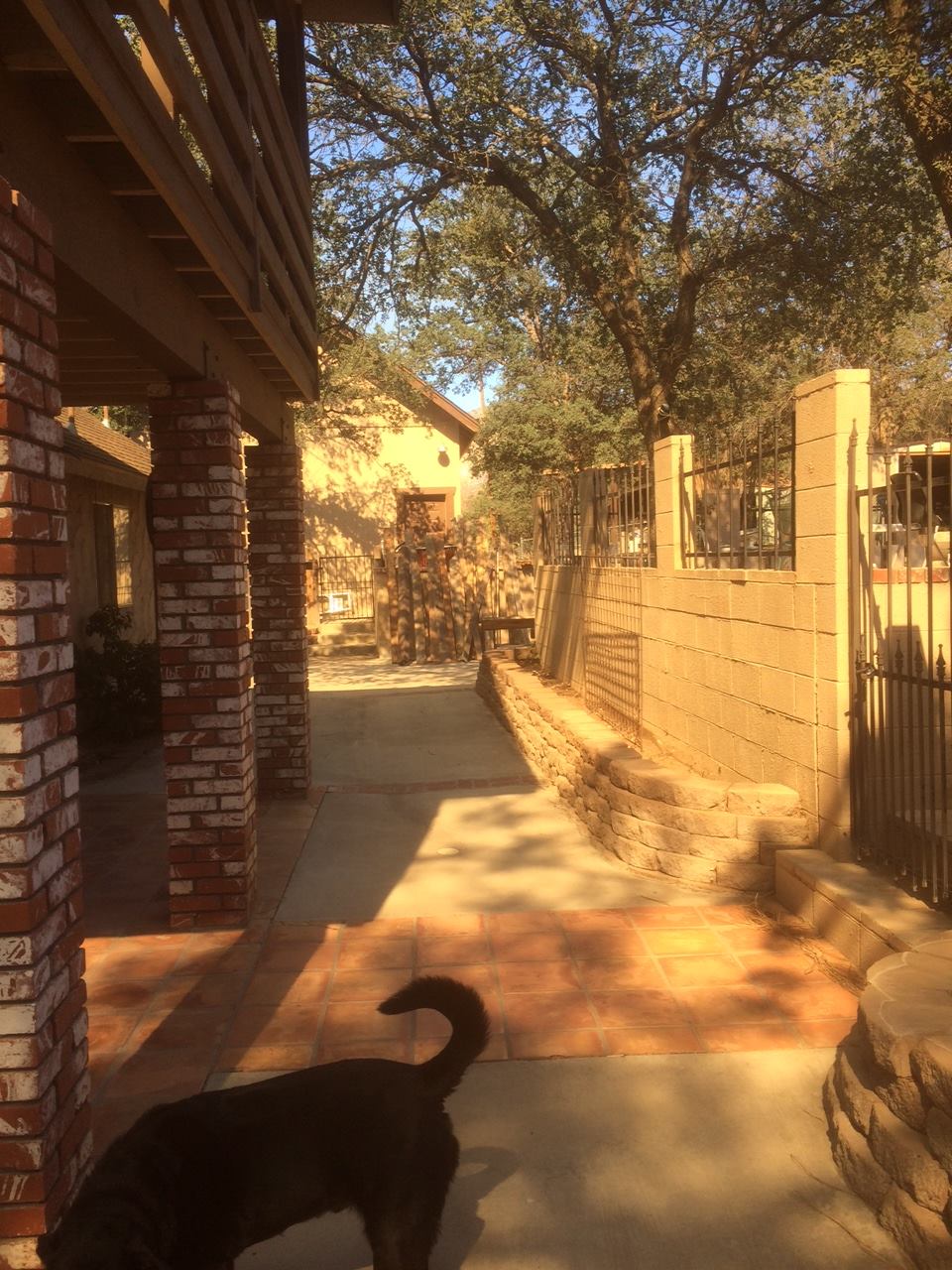
    Abby lived the best years of her life at Cook Peak. Inside, the house was enormous to her. In the fenced backyard, there was a gigantic dog run behind the garage; a back patio the length of the house, a kennel area with an automated water spigot, plus, there was plenty of space around the cement pond to run laps. Compared to her tiny backyard in the city with only a flowerbed for relief, Abby lived in dog paradise. Her transformation from a city dog to mountain canine was inevitable. We were too busy to drive her to Bakersfield for pretty haircuts and gave her bad ones ourselves with sewing scissors. We changed her diet to dry food for fat dogs. But the best change occurred when Abby stopped bolting. We decided that rather than forcing her to live behind walls and fences, we’d open the front door and let her go. She always came back. Mostly she made her rounds and chased a squirrel or two. Her favorite pastime was sprawling on the grass in our front yard and dozing in the sunshine. When she was ready to come inside, she knocked.

    I told Liz, absolutely not! We had already collected too many animals in a short amount of time, a common problem for newbies. Acquiring another dog, especially a time-consuming puppy, was ludicrous. Coldly, I told her to take the dog to the animal shelter. I tried my best to ignore its cuteness, how sorrowful his eyes looked and how proud I was that Liz had rescued him; but it wasn’t my problem. It was hers. The rule was no more pets. Period. David heard us arguing, and he intervened.

    Liz named the puppy Luke after her black Labrador Beenie Baby and then left us for three months to work at a summer camp in the Sierras. While she was gone, the rest of us crate-trained, potty-trained, fixed a hernia and began raising one of the best, unexpected dogs a family could ever wish for. We didn’t care that his pedigree was a mix somewhere between a Labrador and shepherd, or that he shed all over Cook Peak or that drooled when we ate in front of him. He was in tune with our emotions and knew when we needed his company. He was cuddly and loveable. He was our protector. If a stranger came to the front door, Hernia Dog was frightening. At night if the hair on his back stood straight, we knew the bear outside. Hernia Dog was the perfect mountain dog, but he had one flaw. If the front door was left open, he bolted and ran until his feet bloodied.

    Abby lived a long and happy life at Cook Peak. Her death closed a chapter in our lives that had passed too quickly. When she joined our family as a puppy, the girls were in elementary school. When she died, they were women.

    Hernia Dog is an older dog, now. You can tell by the graying around his muzzle. His teeth are yellow, some are gone, and his eyes are cloudy. He fits right in. He is the famous Facebook dog of Cook Peak, and he generously fills our empty nest.

    Nobody wants a hernia dog.


  • The Fire, Part 1

    July 6, 2016

    I thought it would be easy to sit down and describe what happened to me, but it wasn’t. Keep in mind that my story pales in comparison to those told by neighbors and strangers, especially by those who lost everything in the Erskine Creek Fire.

    My house stinks. I must be getting used to it, which means I probably stink, too. We’ve been cleaning for days, deep cleaning, fire cleaning. Last night we rested with a pint of Ben & Jerry’s Phish Food and watched Ancient Aliens. There we were in our stinky living room, sitting on stinky furniture with our stinky cat, watching a strange show about pyramids in Antartica.

    Lookie-loos are everywhere. They parade up and down the streets in their clean cars, gawking at the devastation. I don’t blame them. It’s hypnotizing to see house after house reduced to ash.

    Here is what happened, from the beginning.

    Firepolooza, 2016

    13575947_10210028938859201_6734936849619734456_o

    I was at my desk, working on a rush job for a client, when I glanced up from my computer screen and noticed the lighting outside was an eerie shade of orange. Fire orange. Hernia Dog and I went outside to investigate.

    13584893_10210028939019205_1790215493461251156_o

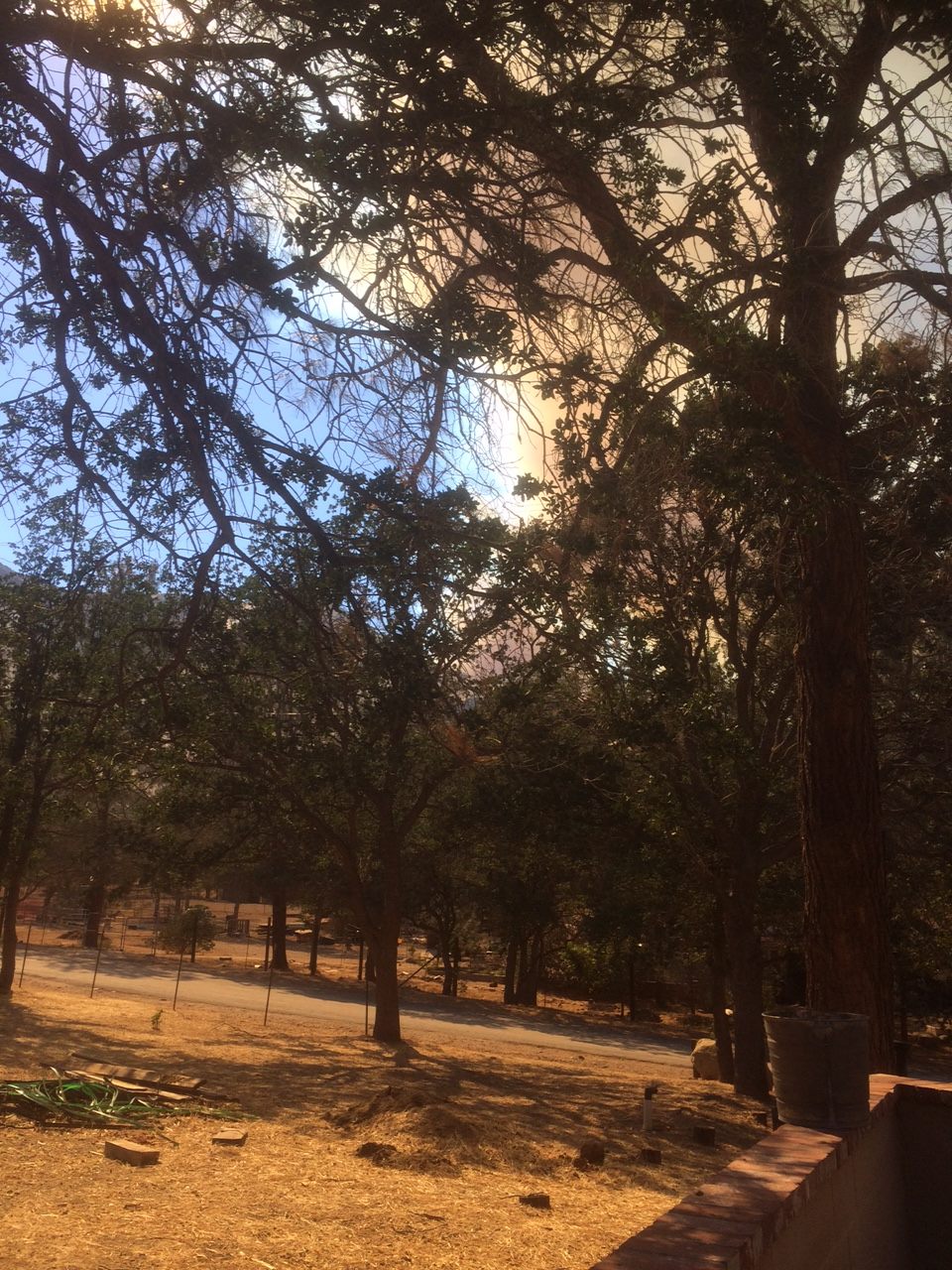
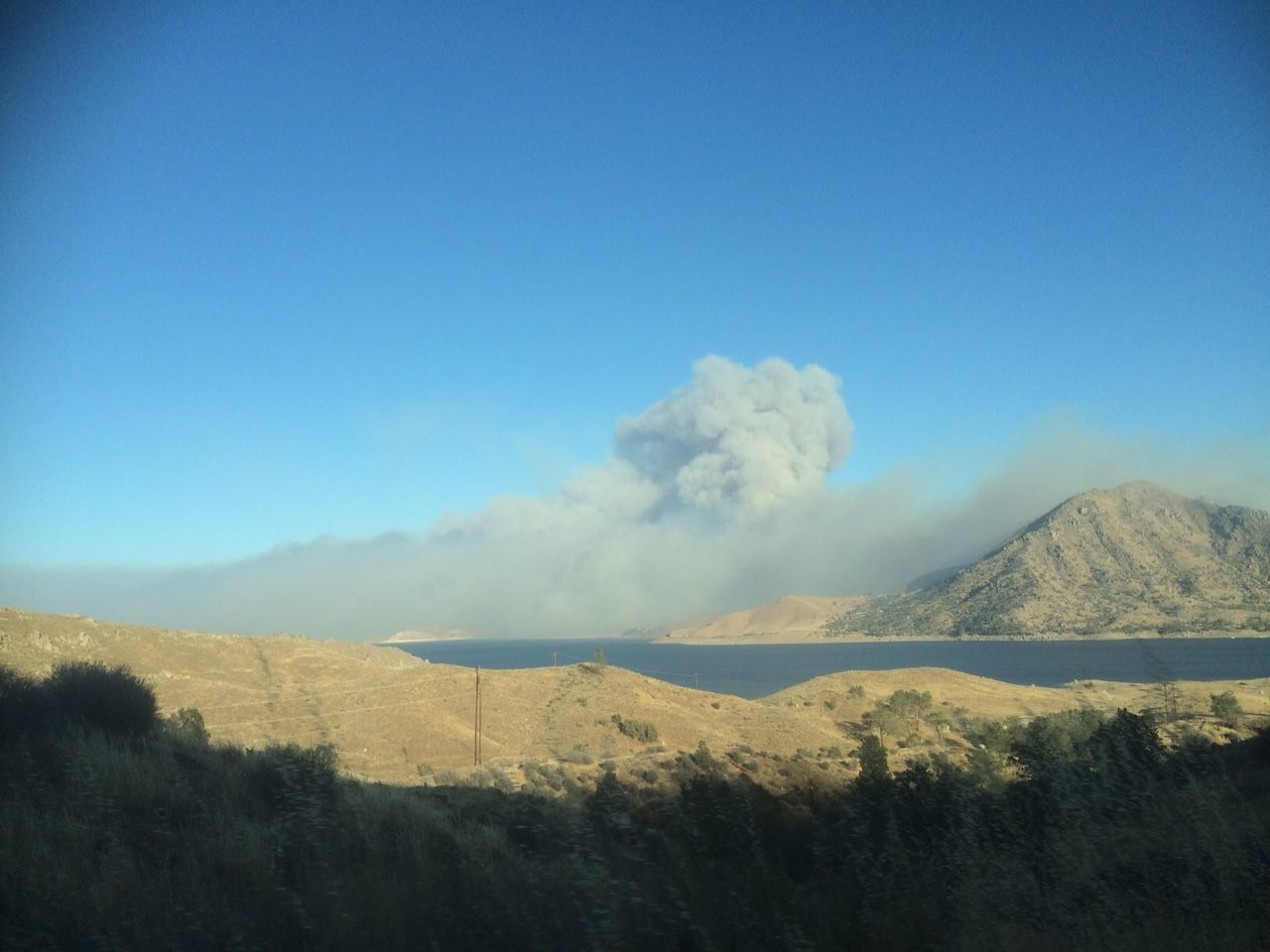
    Smoke was coming from the west, up and over Cook Peak Mountain, driven by gale force winds. Tiny spotter planes circled high above the giant plume like gnats. As the sun filtered through the smoke, it cast a burnt glow. Unfiltered, it was bright white. I had never seen anything like that before. It was beautiful, yet terrifying.

    Do you see the road in the photo above? It goes up to the top of Cook Peak Mountain. Do you see that truck? It belongs to my neighbor. He lives in the last house on my street. Beyond his property is BLM land. People like to go up that road to ride dirt bikes, target practice or admire the view of the valley from the flat spot. That’s also where the neighborhood bear lives.

    13584661_10210028939139208_3318434053220777763_o

    The top of Cook Peak Mountain was now on fire. I could see the flames as pine trees exploded on its crest. I could hear air tankers and helicopters, now, but I couldn’t see them through all the smoke. Then it occurred to me, where were the fire trucks? Who was going to protect my neighborhood? Where were the hotshots?

    I walked across the street to my neighbor’s fence line. Like me, she was looking at the smoke and the flames, wondering what to do. Surreal moments catch you off guard. “Looks like the fire is getting close.” “Sure does.” “The wind is blowing it right at us.” “Yeah, that’s probably not good.” “Do you think we need to evacuate?” “Maybe.” “Shoot, I don’t have a car.” “Where are the fire trucks?” And then we talked about our animals, deciding we’d save our dogs and horses and the rest would be on their own.

    The wind was blowing over 40 mph and blasting the fire towards us. It had charged down from the top of the Cook Peak Mountain and was now less than a quarter mile from my house. I went inside and called David. He said to call my in-laws in Wofford Heights because they could help me evacuate much faster than he could. David was in Bakersfield with our only vehicle.

    10348686_10210028940899252_7173946926320705870_o

    I collected my computer equipment, medications, and my wedding album and put them inside the front door for evacuation. I felt nervous because my in-laws were at least 20 minutes away, and the fire had already reached Cook Peak.

    Outside, the wind roared like a freight train. I looked out the art studio slider, and the fire was on our lot next door. In less than ten minutes, the flames had traveled from the top of the ridge, down into my yard. Burning pine cones and embers fell from the sky and splattered like napalm, starting more fires. The side yard, back pasture, and surrounding homes were on fire. I knew I had to leave, even if it meant walking out alone with nothing.

    13580556_10210028940979254_8895997892876566256_o

    I stood at my front window, waiting or my in-laws to appear out of the smoke, but they never did. Instead, a small green fire truck drove past my house and then disappeared into the smoke. There is a fire hydrant in front of Cook Peak. I thought for sure he’d stop, hook up a hose and fight the flames, but he didn’t. A sheriff car appeared. He saw me in the window and soon he was at my front door telling at me to leave my home and save my horse. That’s when all the smoke alarms in the house went off as thick smoke poured in through the open windows. My eyes and lungs began to burn. I found Hernia Dog cowering in the bathroom upstairs. I couldn’t find his collar or leash, so I put a belt around his neck and dragged him outside. A neighbor was in my yard talking to the Sheriff. I asked him to watch my dog while I tacked up my horse.

    Amber was standing in the pasture; her eyes fixed on me. The fire burned a couple of yards behind her. I knew I had to appear calm for her sake. I spoke softly and buckled her halter onto to head, but I couldn’t find a rope to lead her. All I could do was hold onto the side of her head and hope she was okay with that.

    The fire was now in front of Wilma’s pig pen and blocking our only exit. I walked Amber to the end of the pasture and tore down a section of the barbed wire fence to escape. Sadly, I  knew I could not go back and get Hernia Dog from my neighbor. There was no way I could control a dog and a horse at the same time in the midst of so much chaos. Amber and I walked out of the firestorm and into the unknown.

    13603469_10210028940939253_2948887913001831162_o

    As Amber and I walked along the road, fire trucks and sheriff cars drove into the smoke with flashing lights and sirens. That’s when I realized the emergency personnel were not there to save property. They were there to get as many people out alive as possible. The massive fire was out of control, and there was nothing anyone could do to stop it.

    I spoke to Amber as we evacuated. I told her what a brave girl she was and how we were going for a walk to get some fresh air. Her senses were heightened, but I was calm, and she sensed that. Moments after I snapped the photo above, smoke enveloped us.
    I had to get us to higher ground so we could breathe. That’s when a man with a horse trailer stopped and asked if Amber needed a ride. He said he was only evacuating horses and would come back and get her. What about me? We kept walking higher in elevation towards cleaner air until the man with the horse trailer found us and took Amber away.

    I walked back to the main road and waited for my in-laws, in case they were driving around searching for me. I stood with my shirt sleeve covering my mouth, swirled in smoke, coughing and watching car after car pass by me. I could tell everyone in Squirrel Valley was evacuating at the same time by the crazy way they were driving. I knew I had to get out. The fire was blasting towards me, again.

    To be continued.


  • Ann Was Here

    I have lived overseas, circled the globe numerous times and met people from some of the most exciting places. But the day after I graduated from high school, I returned to the United States and was assimilated.

    Bakersfield, California is where I settled. I left for a couple of years to attend art school in the Bay Area, but I returned for my first job in a Bakersfield advertising agency. I married a Bakersfield man. We raised our family on a cul-de-sac off Rosedale Highway, and my roots grew deep, something I felt I had missed growing up.

    Even though Cook Peak was only 60 miles from Bakersfield, I was apprehensive about leaving the life we had created. Selling points of clean air, a slower pace of life, snow in the winter and acreage made sense to me, but the fear of change was paralyzing. How could a gal who grew up in Pakistan, Thailand, and Malaysia be afraid to move 60 miles? Ridiculous, that’s what I told myself. I was embarking on the most significant adventure of my life; my roots could grow deep again.

    Sometimes I think about my globetrotting days. They are beautiful memories of a lifetime ago. I think about my childhood friends who live and work on the other side of our planet. I think of those who go on vacation and the ones with gumption who travel alone to exotic places and blend in. I envy every one of them, and sometimes I feel stuck.

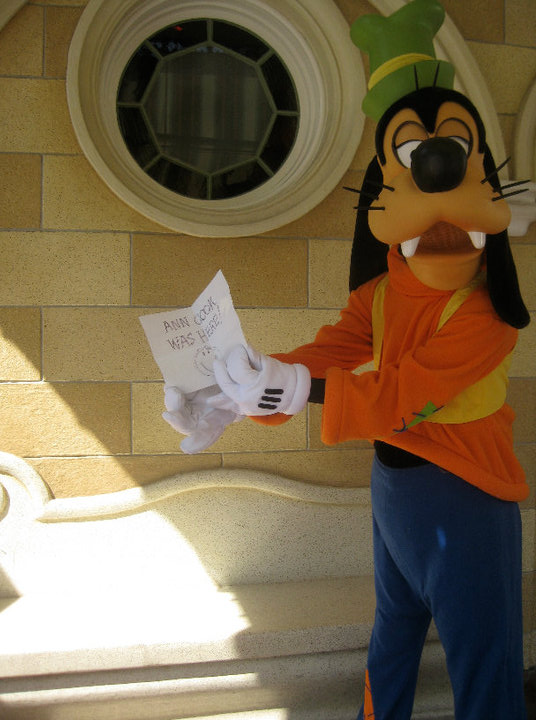
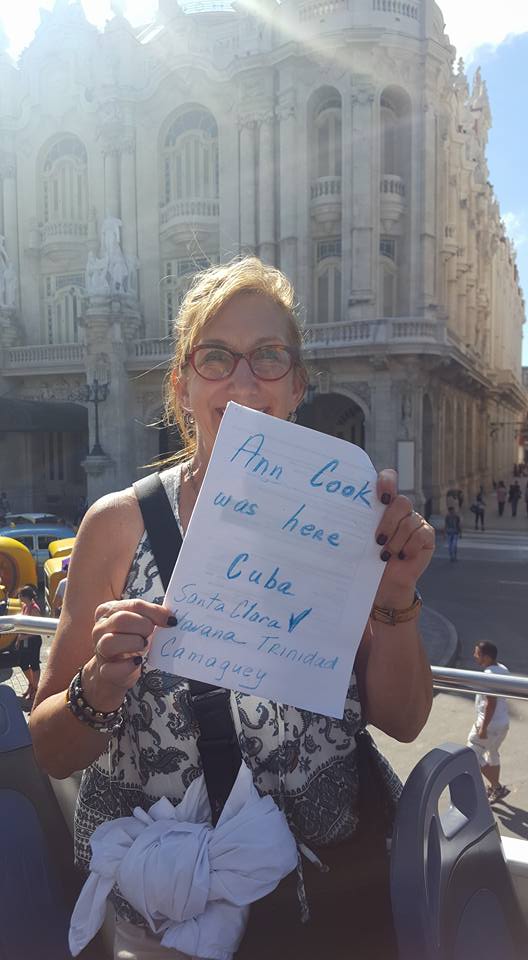
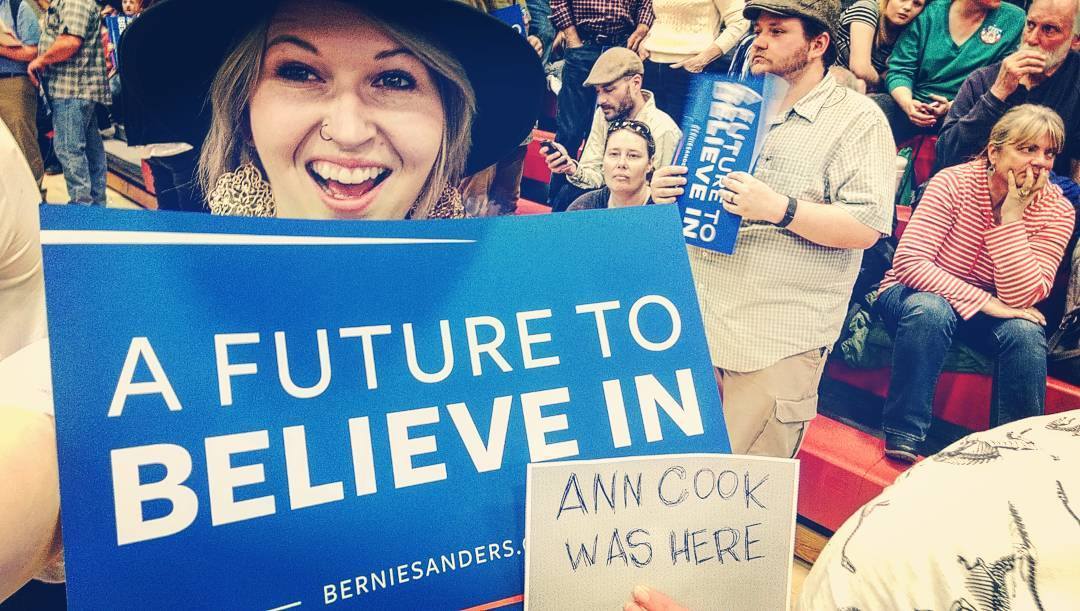
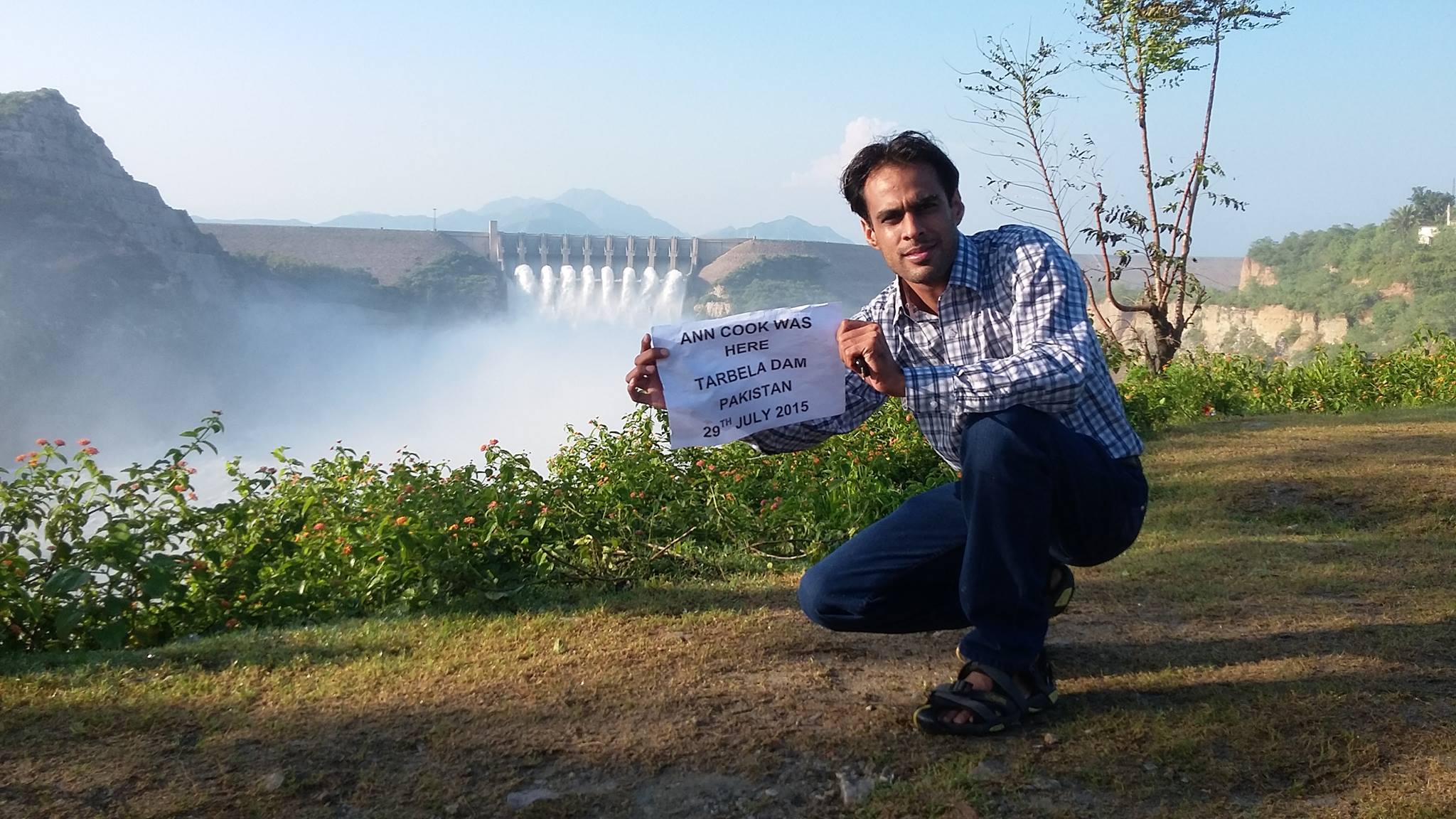
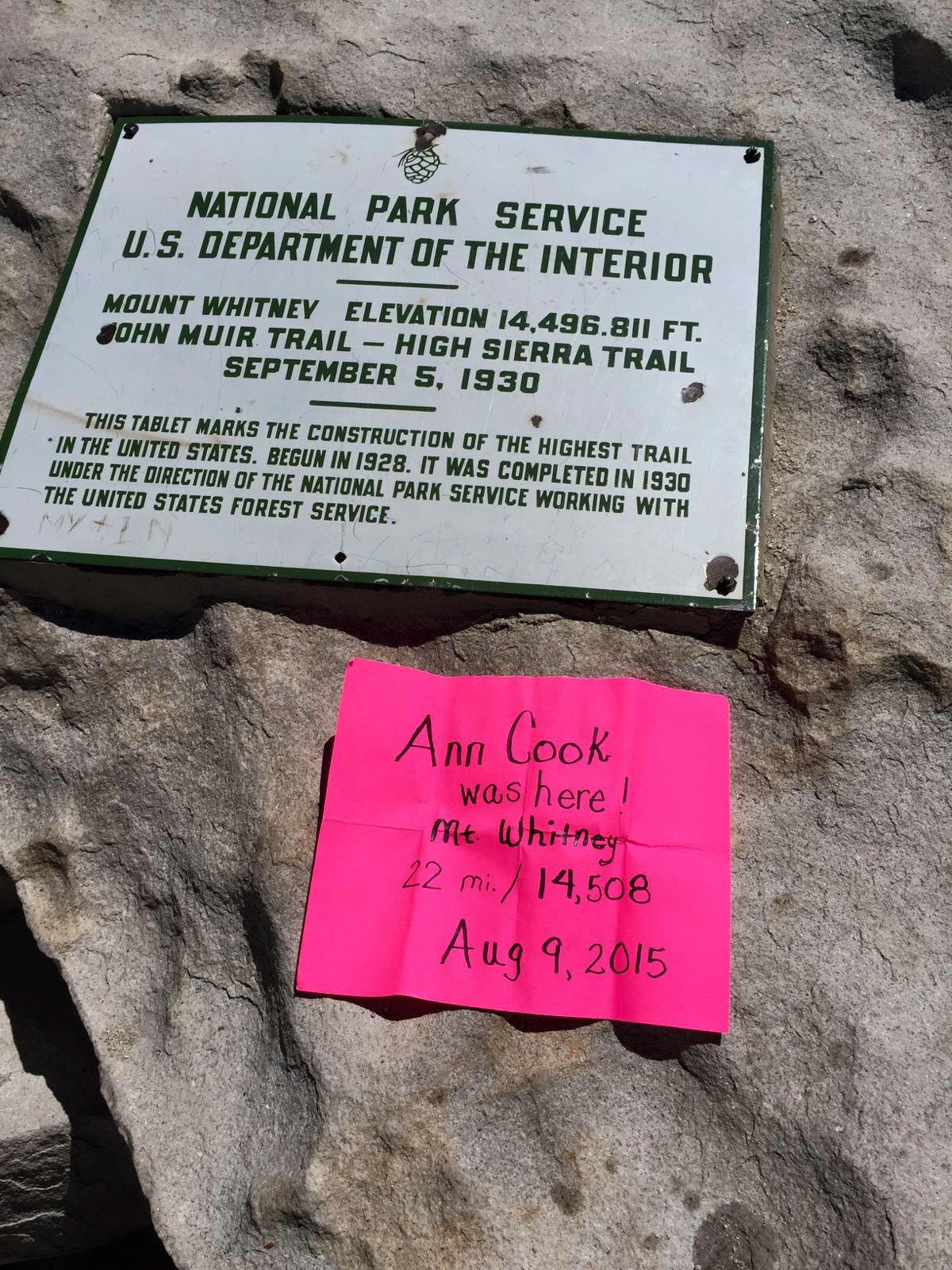
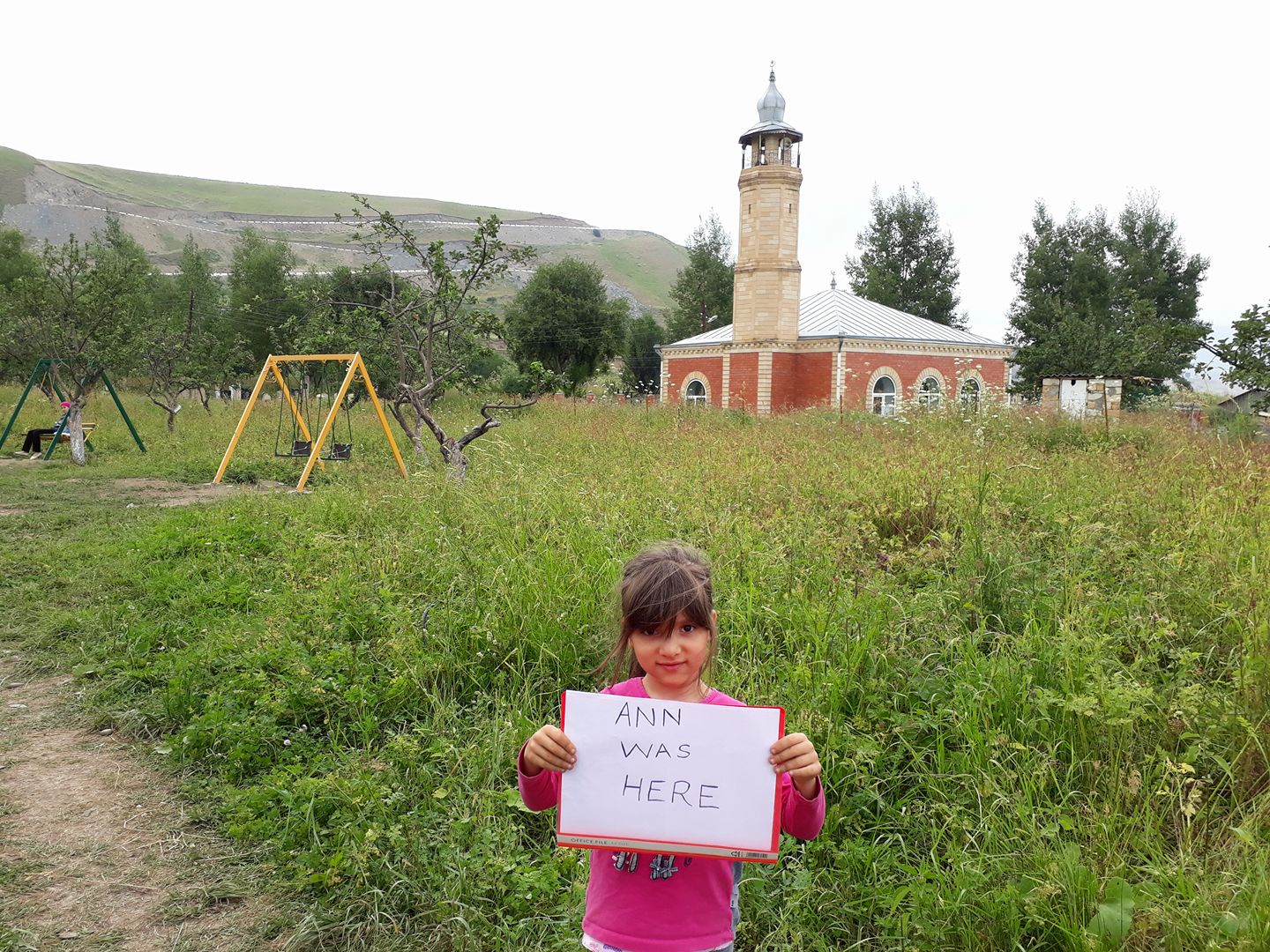
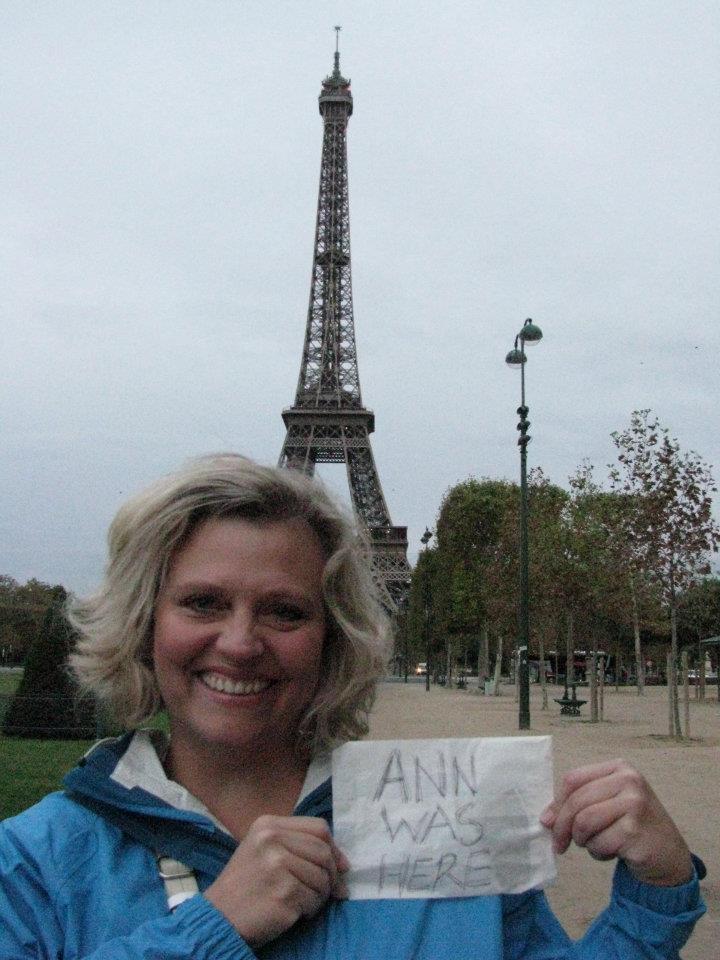
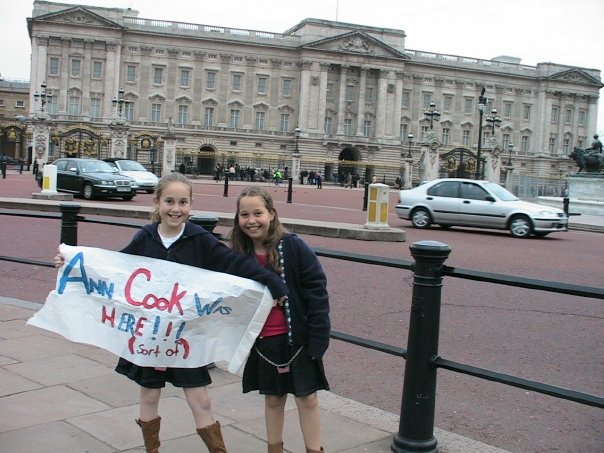
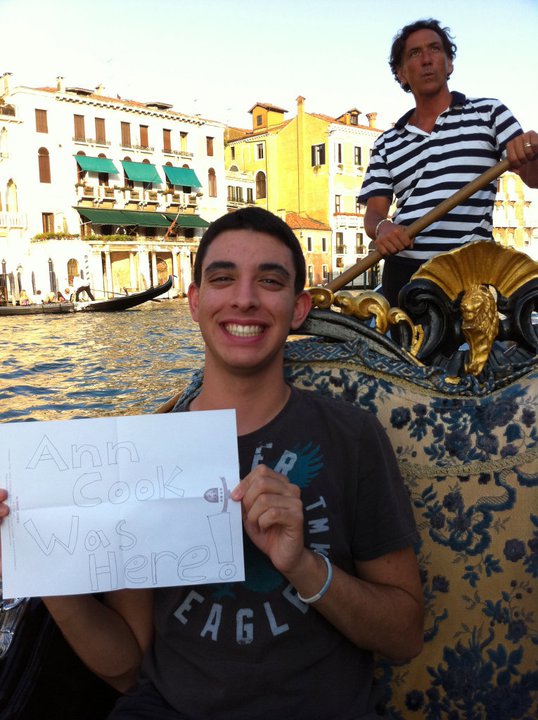
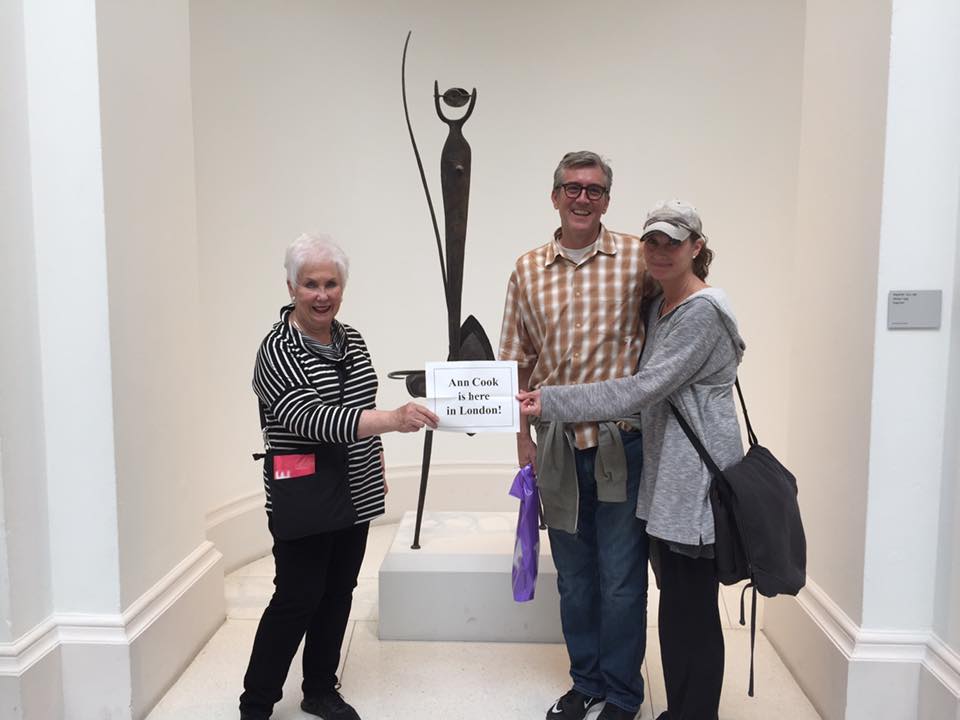
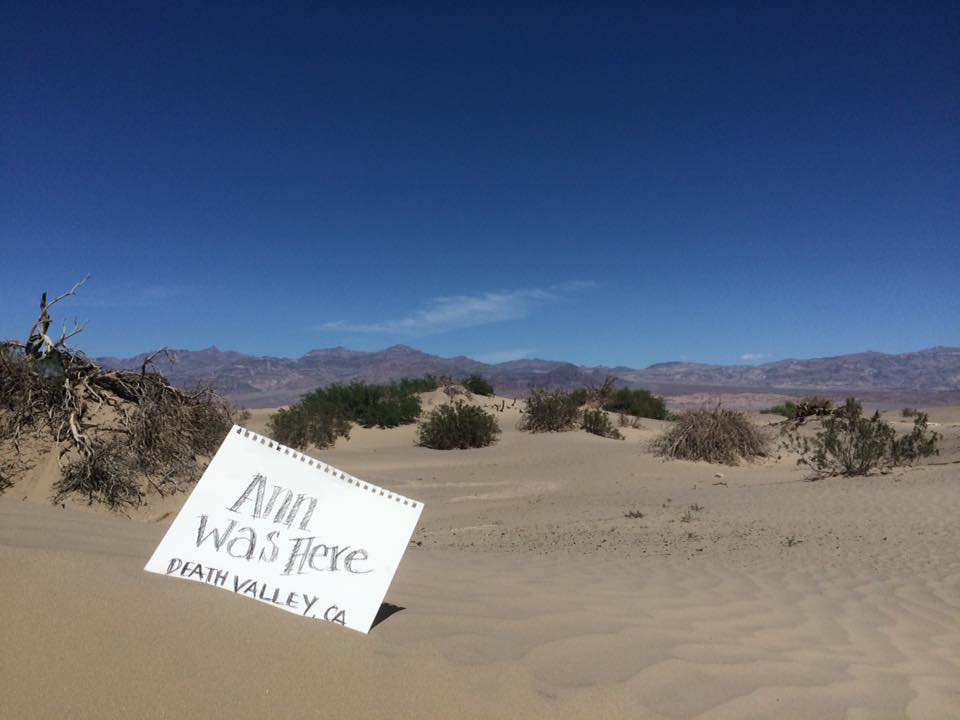
    I found a creative way to travel again. Already I’ve visited Cuba, Nepal, Russia, Indonesia, Japan, Thailand, France, Morocco, Casablanca, Australia, London, Germany, Washington DC and many more destinations. I did it with “Ann Was Here” signs and a little help from my friends. Here are some of the hundreds of photos I’ve collected documenting my armchair travels. Enjoy!

    60436_1607991398850_2308462_n

    15179098_10207844078406824_1630619221418362322_n

    13912372_10205392051159605_7278151982459677016_n

    18767559_664165447104663_6664462528101659810_n

    12322907_10209096727194492_7983656766955844820_o

    11754306_1483759958604260_5136510441352258065_o

    11884083_10153182147553335_6981944230583678025_o

    10534055_10205590293415839_3560163481922484676_n

    10421596_10205590218773973_4469156332621322986_n

    20543626_10213950446581371_4830885205975405529_o

    302564_2496764537623_1388634364_n

    1455856_10205590216733922_4665569679418468303_n

    3288_1155022994923_5814795_n

    12079236_10204859588511271_1871876060467168448_n

    4249_1165312412152_1598844_n

    262015_2231305341309_7565372_n

    13887095_10208882103403203_6027173520952435753_n

    17757328_10212796354282857_2208557300235875716_n

  • Cement Pond

    We ripped out the lawn and filled our tiny backyard with a giant above-ground pool; leaving our Schnauzer with only a flower bed for relief. We built the perfect Sunset magazine redwood deck that hugged the vinyl on two sides and connected to our spa. We purchased patio furniture with matching umbrellas and landscape lights that glamorized our Queen’s Palms, Birds of Paradise, and sizeable Spanish-style fountain. We had created Shangri-la on a cul-de-sac in Bakersfield.

    The sales flyer said Cook Peak had an in-ground swimming pool. The idea of encouraging our girls and their new friends to stay close to our home, especially as they grew into teenagers was a brilliant selling point. We knew how to maintain and operate an above-ground pool. Together with the pool store, we tested and kept our water sparkling all year round. How hard could an in-ground pool be?

    I thought of The Beverly Hillbillies the first time I saw the swimming pool at Cook Peak. Speechless in front of 40,000 gallons of saltwater in a pebble-tec pool with a diving board, I felt overwhelmed and out of place. The water wasn’t brilliant blue and sparkly like our city pool; it was ominous with a tinge of green. We forgot all about it over the next few weeks and focused on winning the bid for our dream home.

    It was 105 degrees on moving day. The girls and their cousins played Marco Polo and cannonballed their best off the diving board into the darkness. David and I unpacked the patio furniture that looked miniature on so much scalding concrete. Resting under the umbrella, we planned the pool area landscaping. We envisioned the barren flower beds planted with Nandina, Crepe Myrtle, and Star Jasmine. With landscape lighting showcasing the oak trees and maybe a couple of fountains and more patio furniture, we would create Shangri-la at Cook Peak.

    From the west, the wind howls when the sun dips behind Cook Peak mountain at four o’clock. It funnels through the Sierras to the Mojave Desert like a bullet train. Our first summer, a gust yanked the umbrellas out of their metal bases and threw them like darts into the lot next door. Another blast toppled our patio table and shattered the glass across the concrete into the shallow end. Full of dirt and debris, the pool sweep stopped working, Ellen’s ears got infected, and the cement pond turned green.

    We took a jar of water to the pool store in Bakersfield. The cement pond flunked every test, and the list of chemicals we needed was daunting. We complied, believing the pool store was full of experts. They kept us coming back each week with a new water sample, only to flunk the tests and buy more chemicals in the hope of a different outcome. The cement pond was never passing a city pool test. Frustrated and tired of spending so much money on chemicals and gas, we hired a local pool service who precisely knew how to make a mountain pool thrive.

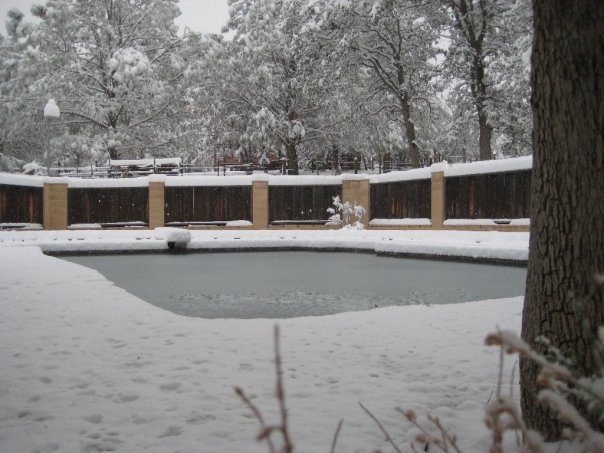
    We enjoyed the cement pond when the girls were young, and so did their friends. My favorite times were sitting on the edge with a daughter on a summer’s eve and dangling our feet in the water. We talked about boys and watched the bats dive-bomb the deep end for bugs. We gave them pet names like Tanker and Buzz. Each year we hosted Hawaiian birthday swim parties and summer BBQs with friends and family. There were diving contests, chicken fights, lazy afternoon tanning sessions, and night swims under the Milkyway. And when the top of the cement pond froze in the winter, we could not wait to break the ice and shuffle it from one end to the other with a broom.

    When I look out my bedroom window at the cement pond below, I think I should swim laps when the weather gets warmer, but I never do. I cannot remember the last time I wore a bathing suit. Our big city plans for the pool area never transpired. Nothing would grow in the flower beds. Landscape lighting would have interfered with the night sky and water cost too much to install a sprinkler system. Instead, we changed our perspective. Now that the girls are gone, I am the one who scoops the leaves from the bottom, the one who adds the shock and the one who saves the bees from drowning in Shangri-la.


    312555_2466449379763_769476323_n

    When the cement pond needs filling, sometimes I forget to turn off the water…

    12466259_10208465646137860_8601756636178121355_o

    Ice crust on the cement pond.

    11095684_10206913760021677_5021413374746097106_n

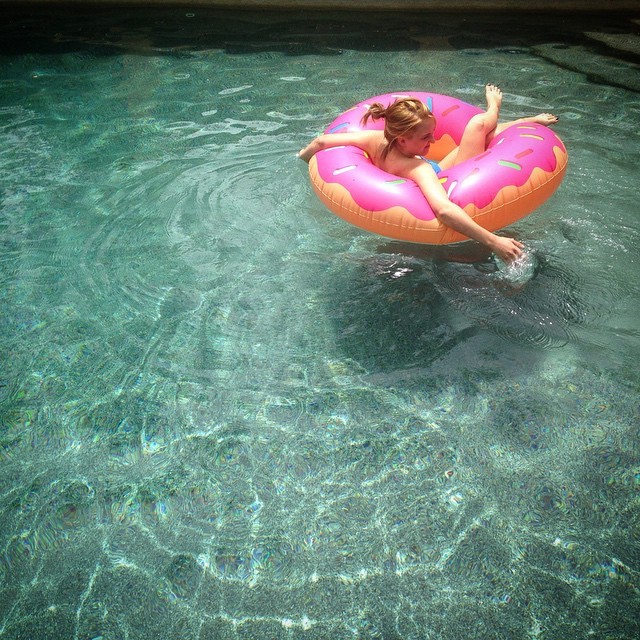
    Floating on a donut.

    132611_1770321577003_3740946_o

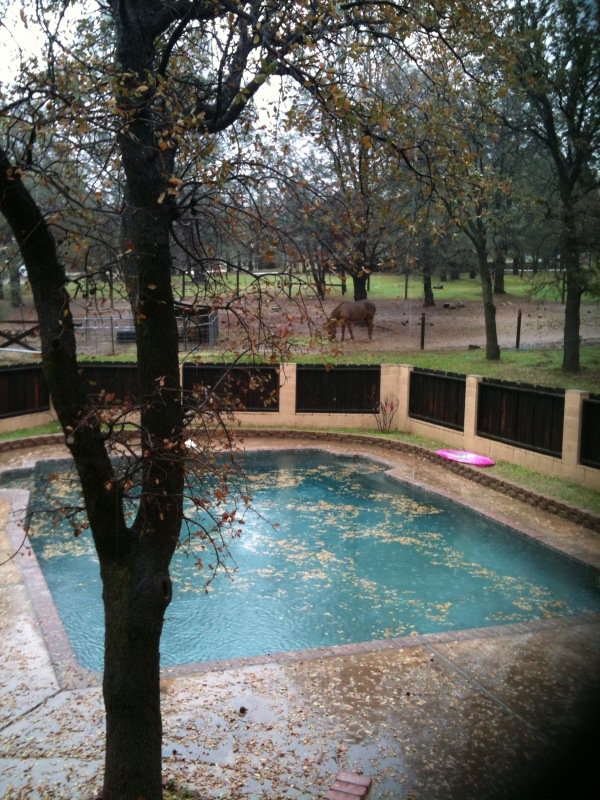
    The view from my bedroom window after a winter storm.

    IMG_4398

    After the Erskine Creek Fire of 2016.

    1351_1081807484581_3078_n

    The cement pond on the best snow day of 2008.


  • Obituary for a Sheep

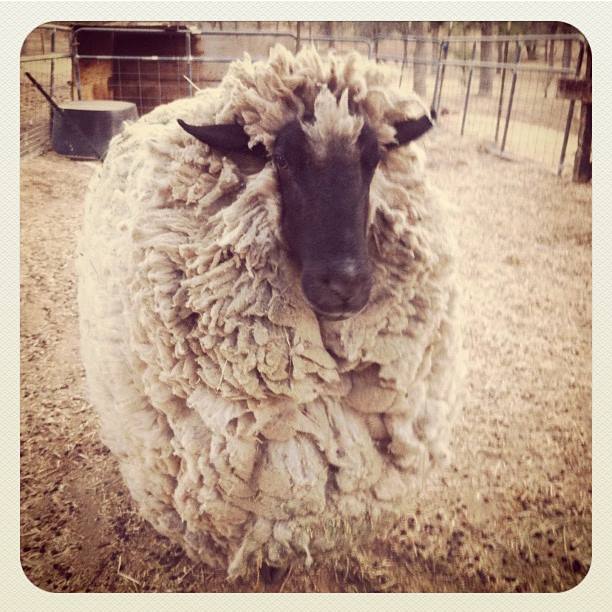
    Jeffery, a long-time resident of Cook Peak, died Tuesday, April 26, 2016, at the ripe old age of twelve. That’s sixty-four in human years and quite an achievement for a sheep! He will always be remembered for his massive wool coat, happy disposition, and keen observational skills, which served as an alarm system.

    Born in 2004 in Kelso Valley, CA, Jeffery was destined to become a 4-H lamb and sold to market. Due to an unfortunate accident with a horse weeks after his birth, Jeffery’s hind leg was broken, landing him at a local vet to be euthanized. Knowing the lamb was otherwise a healthy sheep and worthy of a good home, the vet set the tiny leg in a hot pink cast and called the Cooks.

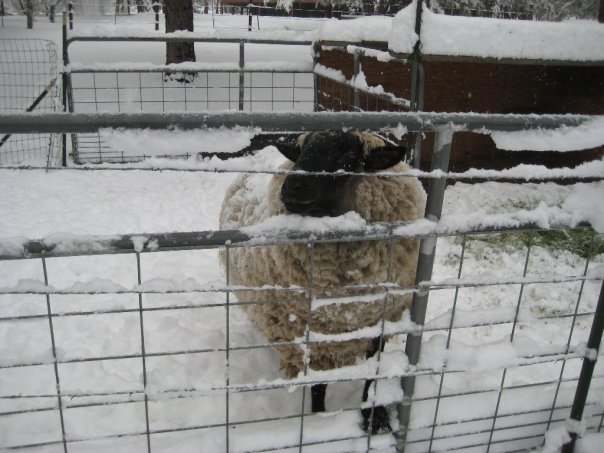
    Jeffery spent the next few weeks bonding with the Cooks on their back patio. He drank formula from a baby bottle on a schedule and wore a plastic bag over his cast on rainy days. Once his leg healed, he moved to the barnyard where he bonded with a gelding named Silverado. Jeffery grew up fast. He enjoyed late afternoon walks with his humans, their horses, a dog and a chicken named Mary. When puberty arrived, Jeffery rode in the backseat of the Cook’s pick-up truck to the local high school where he was banded (castrated). 4-H students and staff were surprised when Jeffery jumped out of the truck like a dog.

    In his golden years, Jeffery enjoyed the company of Wilma and her three pigs who lived on the other side of his fence. Amber, the horse, often slept next to his pen for companionship. When invaded by free-ranging chickens in search for pill bugs, Jeffery didn’t mind. He chewed his cud and watched them or dozed in the sunshine. And when the Ravens picked his wool to line their nests, he gave freely and never flinched.

    “I’m sad Jeffery is gone,” said Ann. “It wasn’t easy to say goodbye to such an iconic figure of Cook Peak. I’ll never forget the last time I took him for a walk. Liz and Ellen rode along on their horses. Jeffery was full grown and very, very strong. I had him on a leash like a dog, but it was debatable as to who was walking whom. He wanted to go with the girls and their horses into a field, so he came up from behind me, between my legs and carried me off on his back. I was mutton busting and could have suffered serious injury. After I bailed into a ditch and checked to make sure nothing was broken, I got the giggles and limped home.”

    At Jeffery’s death, he was attended by a veterinarian and his human parents who comforted him. They stroked his face and told him what a good boy he was and how much they loved him as he fell asleep forever. Rest in peace, Jeffery.


    13124470_10209490638202021_1416287549240270112_n

    A portrait of Jeffery.

    1351_1081807684586_4185_n

    Jeffery stayed warm during the snow of 2008.


    26035_1401583478781_3767957_n

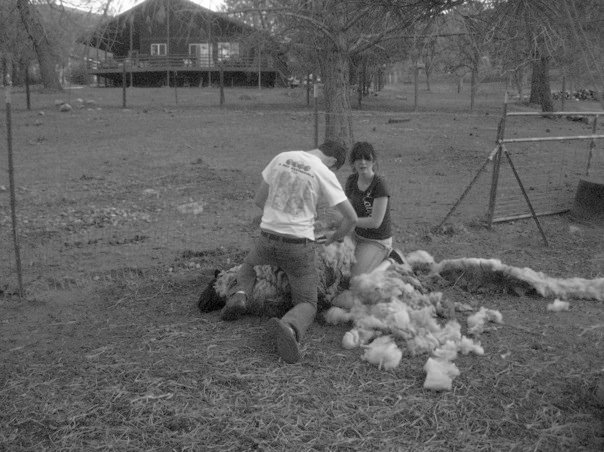
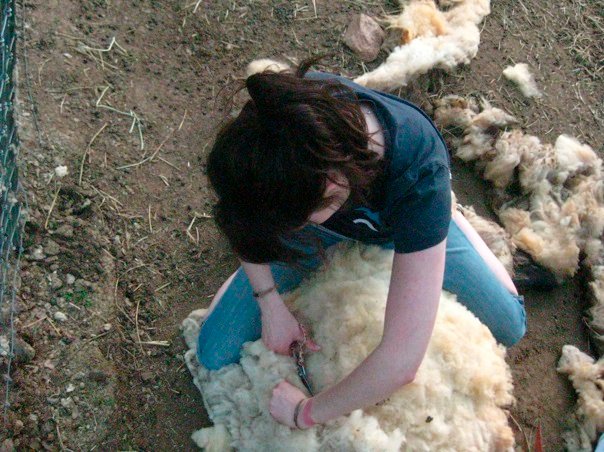
    Although this scene resembles a butchering, Jeffery is getting a haircut.


    26035_1401583638785_3451928_n

    My daughter is using my good sewing scissors… Who would have thought she would later become a successful cosmetologist.  Jeffery only got half a haircut that day. Both kids developed too many blisters to continue.

  • Snow

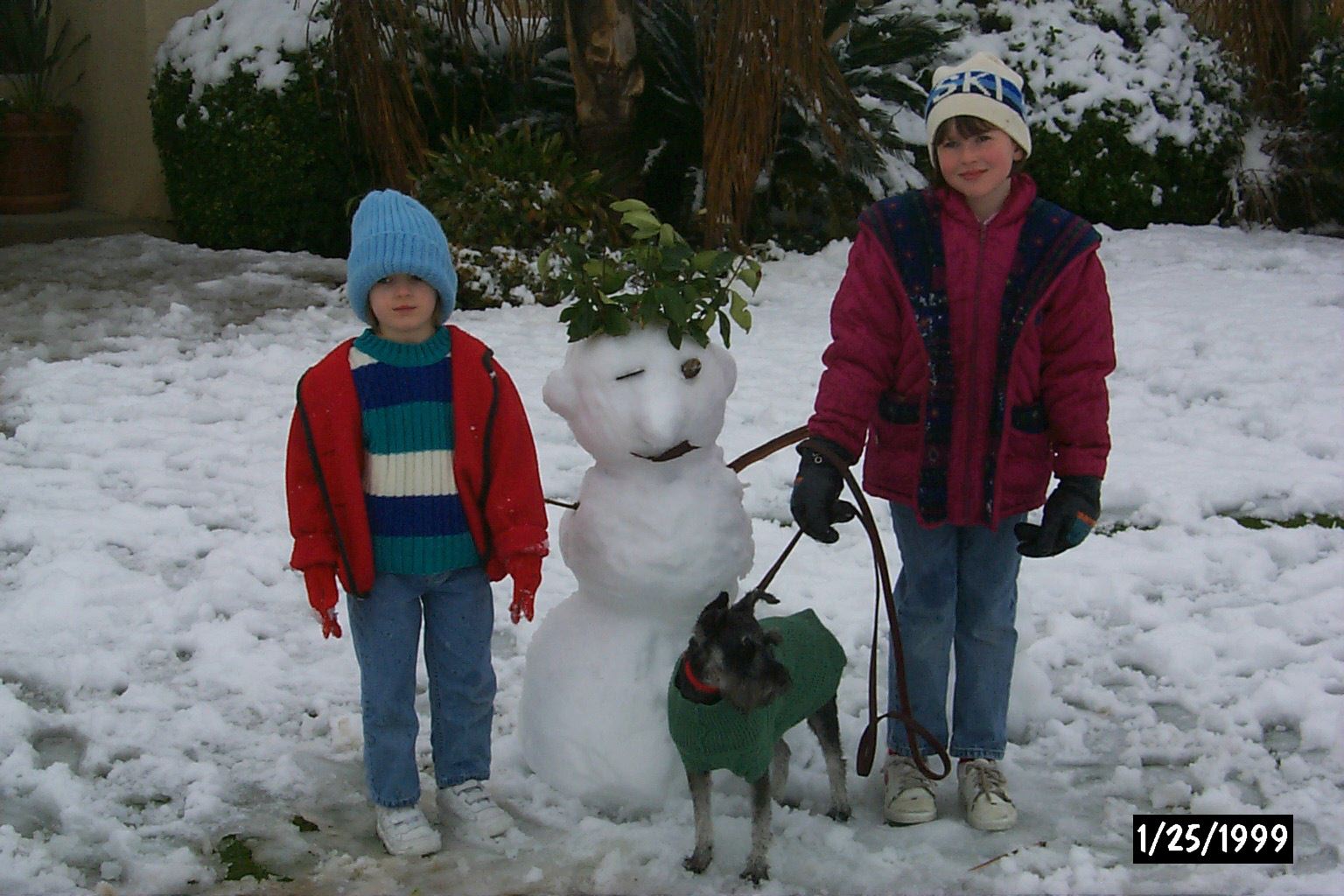
    In 1999, it snowed enough to build a snowman in Bakersfield. We bundled the girls and bolted out the front door into a glorious, unexpected Wonderland. Friends called, wanting us to explore the city, but we declined, sure of weather-related mayhem on the streets of Bakersfield. Instead, we helped our young daughters roll snow across our white Bermuda lawn until their snowballs grew large enough to stack. “Bubba” was his name. He became one of the many snowmen featured in the local newspaper the next week.

    They say it snows in Bakersfield once every ten years. I think they’re going on twenty.

    My parents introduced me to snow as a toddler. I know because I saw myself in a family photo album. I looked unimpressed posed in a foot of snow with my brother.

    The first time I lived where it snowed was in junior high. I went to boarding school in the Himalayas of Pakistan where snow was a significant event. I was so excited the first time I saw it fall in the headlights of our school van on the way home from Jhika Gali; I forgot to breathe. During the brutal winter months, much as American schools do in the summer, my school closed for the winter. Sadly I returned home to be with my parents in the Northwest Frontier Province and counted the days until spring when I could go back to school and enjoy the snow before it melted.

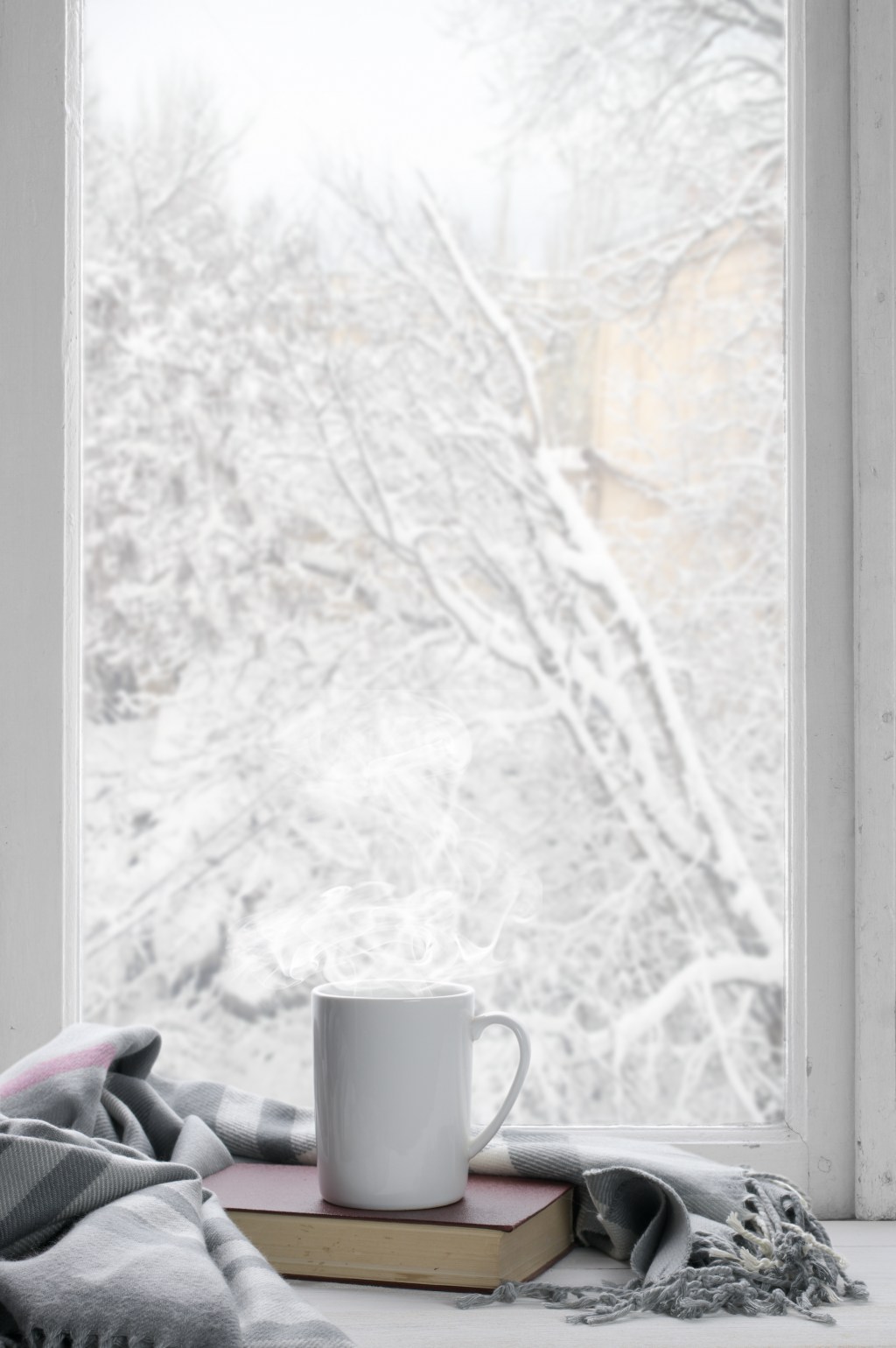
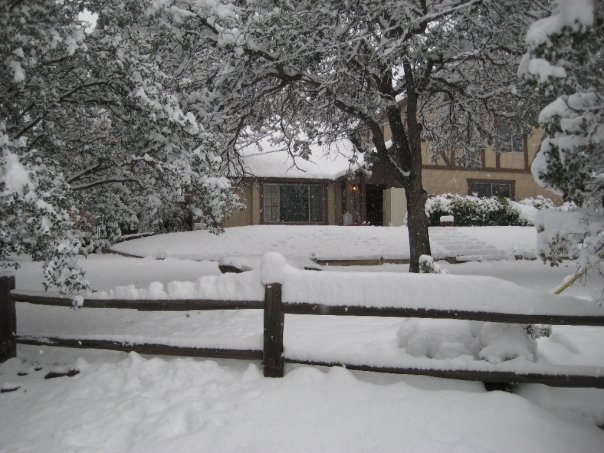
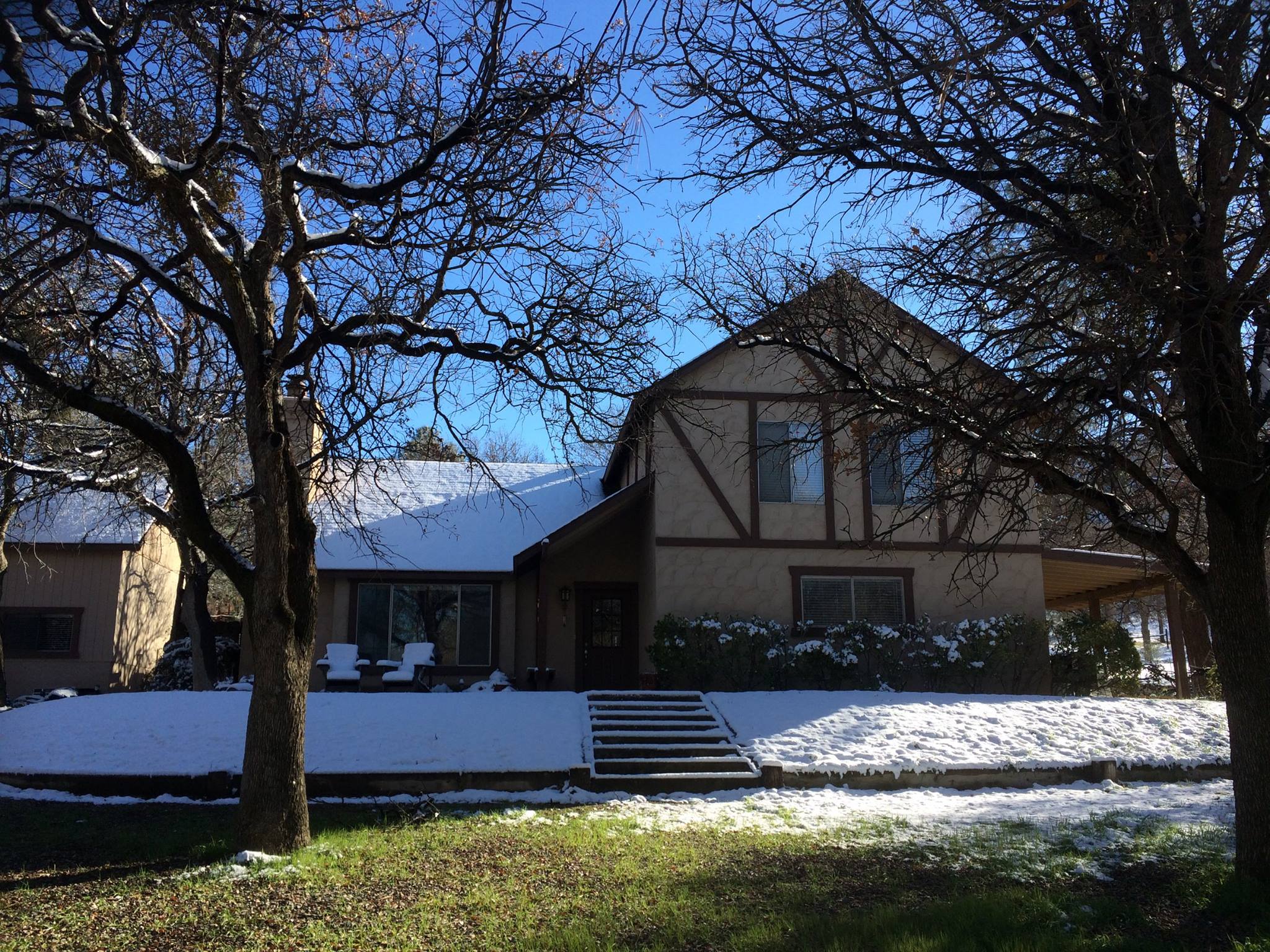
    Last week, it snowed at Cook Peak. I stood at my picture window with my coffee and watched giant snowflakes tumble from the sky. It reminded me of our first winter at Cook Peak as a family when we fawned over every snowflake, every dusting, every time we looked out a window and saw white. We loved and measured every inch and mourned its melting.

    The girls have grown up and moved away. It’s just me at the window now watching the snow fall and feeling I’ve come full circle. I can’t help but notice how quiet it is when it snows at Cook Peak.


    10258021_10205331620709183_4076090476550560064_o

    The last time it snowed in Bakersfield was in 1999.


    1351_1081807644585_3959_n

    The best winter at Cook Peak, 2008.


  • Falling Cow

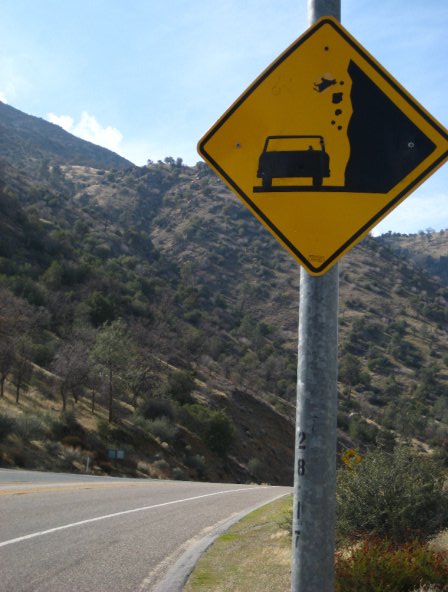
    At the east entrance of The Canyon, there’s a yellow and black pictorial road sign warning motorists to beware of rockslides in the canyon. If you slow down and look carefully, among the rocks is a falling cow.

    We drove through The Canyon on a Sunday morning. It was a bright blue day, and the poppies were magnificent. Just west of the Richbar campground, the halfway point, we came around a corner, and in the middle of the road was a dead cow. Brown and full-grown, it lay on the double yellow line surrounded by rubble with all four legs pointing north. The cow had lost its footing on the steep green hillside and somersaulted hundreds of feet to its death.

    Cows on the road can be dangerous. I know. I hit a black cow on a moonless night at 50 mph and survived. The cow and my car did not. I shudder to think a similar tragedy could happen in The Canyon, but I know it’s possible. We were lucky on that particular Sunday morning. It was daylight, and a motorist had flashed his headlights half a mile back, signaling trouble ahead. We warned others in the manner until we exited The Canyon and called 911. After an odd exchange, the operator dispatched the highway patrol.

    We enjoyed our day in Bakersfield and forgot all about the cow. But on our drive home through The Canyon at dusk, we came around the corner and there it was. Judging by the dark smear on the asphalt, someone had dragged the cow by its legs to the side of the road and placed a large orange traffic cone on top of its bloated body.

    I don’t want to know what happened after that. I can only imagine the corpse remained overnight until CalTrans could dispose of the body in the morning.

    When I drive in The Canyon and see cows grazing on the mountainside, I can’t help but feel a little paranoid. Not only do I watch out for the line-cutters, slowpokes, and risk takers; I watch for falling cows.


    19041_1357413614562_4574055_n

  • shutterstock_77440486

    I refused to drive The Canyon before we moved to Cook Peak. Its 20 miles of windy road churned my stomach, especially late at night. The road is narrow. People drive too fast. They cut corners, tailgate, pass unsafely, and flash their high beams and middle finger. My worst fear, crashing head-on and plunging hundreds of feet to my death, made the road a terrifying experience as a passenger. The idea of driving the artery myself was out of the question.

    A week before moving to the Kern River Valley, David suggested a Sunday drive. Our destination was an apparent surprise, but I knew. We drove toward the east side of Bakersfield, past Mesa Marin Raceway, down the long hill, and through the orange groves in our shiny green mini-van. We were going to drive by Cook Peak for the last time. During escrow, we made the journey often. We imagined our van parked in their gravel driveway. We re-landscaped their front yard and debated a horse or two in their pasture. Soon, Cook Peak would be ours.

    David pulled off onto the side of the road by the old Merle Haggard place and turned off the ignition.

    “What are you doing?” I asked.

    “Do you trust me?” he said.

    I did. We’d been married for decades. With two daughters and a perfectly manicured Schnauzer, I had proved my resolve. We were going on an adventure that would change our trajectory, even though friends thought we’d lost our minds. We were trading our safe cul-de-sac life in the city for country living. I wanted it as much as he did. We all did. Of course, I trusted him.

    “Don’t say anything. I just want you to listen,” David said.

    My hands began to tremble.

    “Today, you’re going to drive the canyon.”

    “No, I don’t think so,” I said. I wanted to go home.

    “I’m serious, Ann. You can’t live in the Kern River Valley if you can’t drive in or out of it. I know you can do it. Take your time. Don’t worry about the other drivers. We have all day.”

    I sat straight and drove slow, pulling off at every turn-out. I even pulled out when there wasn’t a turnout and caused a ruckus. In the narrowest sections, I gripped the steering wheel, squinted my eyes and aimed for the middle of my lane like a boat in a canal. One wrong move and I’d lose a side mirror, clip an oncoming car, or scrape my paint job on a rock face. A drive that should have taken 20 minutes took me well over an hour, but I did it. And on that particular day, I began my love affair with a dangerous road.

    When my daughters learned to drive, I taught them The Canyon. We practiced at night when headlights were easy to spot, and traffic was light. Their driver’s education final required chauffeuring their instructor to the Starbucks on the east side of Bakersfield. Passing that test was a rite of passage. It was freedom. It meant they could go to Bakersfield College and commute with confidence. It did not take long for them to boast driving The Canyon in less than 20 minutes and cause me to worry.

    Delays in The Canyon are common, accidents, fatalities, construction, a gas tanker explosion, mudslides, earthquakes, a plane crash, drownings, search and rescue practice, falling cows, and all the summer slowpokes with a mile of cars trailing behind them. For closures that can last for days, we detour south through Havilah, over Lion’s Trail. That road terrifies me! The most unsettling delays are the ones late at night, stopped behind a string of cars for hours, waiting for the coroner to arrive.

    I’ve driven The Canyon for 15 years, now. I know the road by heart and feel its rhythm in my bones. I think of it like an hour’s worth of therapy after enduring Bakersfield traffic, especially on a midsummer’s night with Paul McCartney. We sing together, sashaying through moon shadows and in and out of curves. And when my hour is over, and I pass under the green bridge on the outskirts of town; I roll down my windows and fill my lungs with mountain air. I’m home where I belong.

  • The Rooster Box

    I stuffed him into a filthy pillowcase and drove to a lonely stretch of desert highway. With one hand on the wheel and an eye on the rear-view mirror, I hurled the demon out the window. He bounced hard and tumbled through Sagebrush until he slammed into a Joshua Tree.

    “You are out of my life forever!” I screamed.

    And then I woke up.

    It had been weeks since Cook Peak had slept through the night. Most nights I lay awake, staring at the ceiling. First, I heard one rooster, then mine, then another a few blocks away. And then mine crowed, again. And again. Wrapping my pillow around my ears, I rolled onto my side, and there was David asleep with the last pair of earplugs wedged into his ears.

    Rooster Boy was a handsome chicken. His rubbery comb drooped over his eyes like a bad hair day but handsome. His wattle danged under his corn colored beak. Tail feathers flounced as he strutted, trying not to stab himself with his spurs. A leader, procreator, and hunter, Rooster Boy free-ranged with his ladies at Cook Peak. At night, he returned to the coop as security guard, perched among a fat row of hens and crowed at anything that moved in the night.

    The next morning after my nightmare, I Googled how to stop a rooster from crowing. I wasn’t alone. Scrolling through web pages, I found answers that ranged from surgically removing vocal cords to injecting the poor bird with beef hormones. One suggested a recipe for Southwestern Chicken with mole sauce. The most helpful site described how a rooster needed to fully extend his body to crow, that a confined rooster was a quiet rooster.

    The garage door was heavy, and I felt it in my back. Starring into a mess, I noticed bat droppings again like donut sprinkles on the roof of my daughter’s 1964 VW Bug project. Power tools lined the back wall next to towers of plastic tubs, two filing cabinets, a Harley Davidson with a dead battery and a shriveled tarantula. The tall red tool chest was rolled into the corner, pillaged after home improvement projects. Left behind were the unsung tools collected over decades of marriage. I found a sledgehammer, half a box of small finishing nails and a six-inch protector that would work since the measuring tapes were missing.

    In the side yard, I hunted through the woodpile for scraps. Rooster Boy and his ladies grazed nearby, picking and scratching through the grass for pill bugs. We ignored each other, and I felt strangely in control for the first time in months. I was going to rescue Cook Peak and build a Rooster Box.

    My box resembled a crude three-foot window planter, anchored to the back wall of the chicken coop. Its hand-hewn wood, scavenged from an old Methodist church was held together with tiny finishing nails. I fashioned the lid from a plank of Pergo and two barn door hinges, precisely at the height of eight inches, just like the website suggested. When finished, I padded the inside with hay and waited for nightfall.

    I wasn’t comfortable with the idea of catching Rooster Boy. I imagined terrified hens and Rooster Boy charging with his spurs in a lopsided fight. I didn’t know what to expect or how to load him into my Rooster Box without altercation, but I had to try. My reputation in the neighborhood was at stake.

    After the chickens returned to roost that night and the lighting dimmed, I opened the coop door quietly. Rooster Boy sat wedged between two black hens and watched me with his blinking yellow eyes. Carefully I reached over the hens and with both hands, plucked Rooster Boy off the perch. Some time between reaching and plucking, I bumped a hen, and mayhem erupted. As fast as I could, I shoved Rooster Boy inside the box head first and slammed the lid shut on his tail feathers.

    The next morning, Rooster Boy only crowed at dawn. I found he had worked the lid up enough to pop out his head like a jack-in-the-box. Modifications began immediately. I sled-hammered lawn stakes into the coop’s rafters, creating locks that swung down to hold the lid in place. That night, I awoke to muffled crowing and discovered that Rooster Boy had stretched horizontally and had plenty of room to recline and crow. On the third night, I marched out to the coop, grabbed Rooster Boy and stuffed him inside the box along with six hens. That night, the crowing ended.

    Coyotes howling in the ravine woke me up. I could tell they were getting closer and soon they’d be in my front yard. I pulled the covers under my chin and listened. I wondered if my neighbors liked me again. They seemed friendlier since I built the Rooster Box. They waved when I drove by. One brought me a bag of homegrown tomatoes. And then I thought about Rooster Boy. He was pastoral these days, accompanying his ladies across the road to get to the other side where they scratched among the oak leaves. He was happy. I was happy, and my neighbors were thrilled. Each night we waited for sleep to arrive and take us to a quiet place, inside the Rooster Box.

  •  

    horse-face-139326099592h

    The Cook Peak Review, June 2009 – Edited February 2018

    In the last issue of The Cook Peak Review, Elizabeth described her personal experience with the death of her free horse, Silverado. Shortly after publication, a generous reader gave her another free horse, an Arabian mare named Amber to join Tulsa, our free gelding. They were a happy senior pair.

    Tulsa began limping after a ride and was diagnosed with ringbone. His leg bone had pushed down through the inside of his hoof. Barely able to walk, he dragged his leg behind him, trying to keep up with Amber. Tulsa began losing weight, and his health declined fast. We needed help.

    The vet made a ranch call. It was 100 degrees that day, and Tulsa was laying in the full sun, unable to get up and move to the shade. The vet listened to his heart, shook his head and said the humane thing to do was euthanasia. Coldly, he climbed into his truck and said to hire a backhoe and call when the hole was ready.

    After everyone left, I sat next to Tulsa and cried. I told him I loved him and how awful I felt for what had happened. Stroking the side of his head, I searched his eyes and asked if he was ready to go, something I had always done when an animal faced death. Tulsa seemed to impress upon me that it wasn’t his time, not yet. At that moment, I promised to do everything I could to save his life even though I knew going against the vet’s advice would mean going ahead alone.

    Over the next few months, we nursed Tulsa. We researched equine health and first aid. We applied topical treatments, wraps, and tried various supplements. We talked with horse rescuers in Los Angeles. We changed his diet, spiking his senior feed with corn oil to help pack on weight and used aspirin to manage his pain. During the worst of it, his hair fell out in chunks from his skeletal frame.

    Our Ferrier examined Tulsa and recommended euthanasia. A neighbor walking their dog stopped to reprimand me for my lack of horse experience and my stupidity, and I agreed, but despite all the negativity, we fought for Tulsa’s life. It didn’t matter to any of us that he would never ride again. After all, Cook Peak was his retirement home, a safe place where he could live out the rest of his life with no expectations.

    A year later, Tulsa’s progress was remarkable. He whinnied in the mornings when he saw me and trotted to his bin for breakfast. His limp had disappeared, and the ringbone was in remission. And finally, his brown coat was full and shiny.

    I believe there are three reasons why Tulsa survived his injury: 1) We refused to give up; 2) We listened to the patient; 3) We relied on father time and mother nature to heal.

    Tulsa lived a happy retirement at Cook Peak. It was colic in his old age that ended his life on yet another scalding summer afternoon. We borrowed a horse trailer and drove him to the emergency vet hospital in Bakersfield where they immediately pumped him full of morphine. It was strange to see Tulsa so relaxed and peaceful after witnessing the grueling dance of colic. There was nothing anyone could do.

    Saying goodbye to Tulsa was heart-wrenching. I looked into his eyes and asked if he was ready to go. We both knew the answer. Bawling, I hugged him for the last time and went inside to sign the paper.

    We drove away with an empty horse trailer as big as the void in my heart. Tulsa and the vet stood on the lawn and watched us leave. Once we were out of sight, Tulsa was laid to rest in the shade of the Mulberry tree.

    There is no such thing as a free horse. Every horse costs money in feed and care. I know what “free” means. It means you’re the one who gets to love the older horse to the last day of its life, and you do it freely.


  • milky-way-984050_1280

    I slept alone in my room as a child, hidden beneath the covers with a hole small enough to breathe. I wasn’t afraid of darkness; I felt terrified of the dangers that accompanied darkness, the monsters, the intruders, and lightning on stormy nights. Hidden beneath the covers, I felt safe in my cocoon.

    Boarding school helped calm my fear of darkness. I was never alone in a room full of bunk beds. Although I continued to hide when I slept, I did so out of necessity. Himalayan winters were brutal. In high school, while visiting my parents in the jungles of southern Thailand, I hid for a good reason. The communist guerrillas had threatened to kidnap an American. I was American.

    When I returned to the United States for college and later married, my fear of darkness disappeared. I pulled the covers up under my chin every night, stuck out a foot and fell asleep effortlessly. There was nothing to be afraid of. We lived on a cul-de-sac in suburbia where the night glowed from the nearby Walmart and helicopter searchlights patrolled the murky sky. Darkness wasn’t dark at all.

    On our first night at Cook Peak, David asked the girls and me to join him by the pool to see at the stars. Surrounded by a wood fence and a wall of Juniper trees, the pool area was a private mountain oasis. I switched off the porch light and felt my way up the steps and through the gate, directed by a Marco Polo routine. Once night blindness subsided, I looked up to the heavens and marveled. I saw the Milky Way for the first time in many years, a broad stroke that filled the sky from horizon to horizon. It was an orchestra of stars and Orion was the first chair violin.

    While David named the constellations and explained star clusters and red dwarfs, the girls and I suddenly realized wild beasts lived beyond the pool fence, watching us. Earlier in the day, the previous owner had told us about a black bear in the pine tree. She said raccoons frequented the upstairs balcony after midnight, which happened to be right off my bedroom. She also reassured us not to worry when coyotes screamed like colicky babies. We’d get used to it. They were just flushing out the cats. Huddled as one, the girls and I shuffled toward the house, trying not to be rude until David was left explaining black holes to a Schnauzer.

    I am not afraid of the dark, but I do have respect for darkness and all of its inhabitants. I know what’s out there. We rarely turn on the porch light, and I can’t remember the last time we used a flashlight or if we own one anymore. We have grown accustomed to the darkness and cannot imagine living in a city that never sleeps. And now when the coyotes scream in the middle of the night, or the bear ransacks our trashcans, it’s easy to fall back to sleep, safe in our cocoon.

  • Nobody

    After the Erskine Creek Fire of 2016, the feral cat population dwindled to one; a cat called Nobody. Nobody had belonged to the big white house on the hill above Cook Peak, one of four in a row, one of 257 homes destroyed by fire. The owners never returned to rebuild or look for their cat. Traumatized by fire and all alone, Nobody moved down the hill to Cook Peak where he lived under the chicken coop. He was a good looking cat, sturdily built with a midnight coat. He lived off gophers and drank from the pig’s trough. I tried many times, but I could never get closer than a car length before he bolted. Mostly, he was content to watch from afar and never wanted more from me than space.
    Last fall, I stopped noticing the cat in the mornings when I fed the pigs, then in the evenings until one day I stopped noticing him at all.

    Feral and outdoor cats don’t last long at Cook Peak. I’ve learned not to get attached. When coyotes scream in the middle of the night, I know what’s going on. It happened Pindi, Ruthie, and my best cat Sheldon. I’ve learned the only kind of cat to have at Cook Peak is an indoor cat. Anything else is a nobody.


  • 12615618_10208671620527091_6773495714193286683_o (1)

    The English name their houses. I’ve always admired their tradition, mostly because I grew up in Pakistan where hill station bungalows were named Robin House, Hillside Manor, and Rose Cottage. It’s familiar to me. When we purchased our home in the Kern River Valley, located on Cook Peak Road at the base of Cook Peak mountain, plus our surname was Cook; it seemed only natural to name our house Cook Peak.

    Cook Peak is a collection of old and new stories about a life, a family and a house called Cook Peak.